IFAN Push-Fit PPR Fittings Pressure Rating Limits: Don’t Wait for a Burst Pipe to Learn This
Do You Actually Know How Much Pressure Your Fittings Can Handle?
Let’s be honest. When most people install plumbing, the last thing on their mind is “pressure rating.” The plumber says it’s fine, so it’s fine, right? But here’s the thing — the pressure rating limit of your PPR fittings is literally what decides how long your plumbing system survives. I’ve seen so many cases where the pipes are perfectly fine but the fittings gave out after three or four years.
Especially with push-fit (heat fusion) PPR fittings, they look solid but their pressure capacity drops dramatically when temperatures go up. Today I’m going to break it all down using IFAN Push-Fit PPR Fittings as the example, so you actually understand what these numbers mean when you’re picking fittings for your next project.
So What’s the Real Pressure Limit of Push-Fit PPR Fittings?
Let me give you the baseline first. Most standard PPR push-fit fittings on the market are rated at PN16 (1.6 MPa) or PN20 (2.0 MPa). Sounds impressive, right? But here’s the catch — that rating is at 20°C room temperature.
Now think about your actual hot water system. What temperature is that? 50°C to 70°C at least. Underfloor heating? Even higher, sometimes 60°C or more. The moment the temperature climbs, PPR softens and the pressure rating takes a massive hit.
Let me show you the real numbers:
| Temperature | PN16 Actual Rating | PN20 Actual Rating |
|---|---|---|
| 20°C | 1.6 MPa | 2.0 MPa |
| 50°C | Drops to ~1.0 MPa | Drops to ~1.25 MPa |
| 70°C | Drops to ~0.8 MPa | Drops to ~1.0 MPa |
| 95°C | Near 0.6 MPa | Near 0.8 MPa |
Look at that. At 70°C, your so-called PN20 fitting is really only handling about 1.0 MPa. Then a water hammer hits and the pressure spikes to 1.5 MPa instantly — and boom, it’s gone.
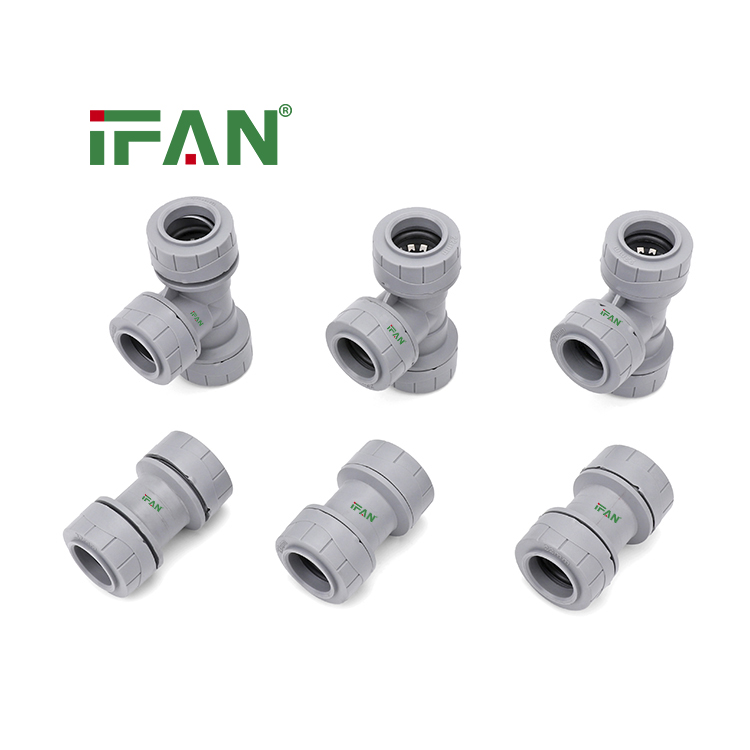
That’s exactly why I always go with IFAN PN25 Push-Fit PPR Fittings. IFAN’s PN25 series holds a steady 2.5 MPa at 70°C — more than double what a standard PN20 can manage at that temperature. And IFAN uses 100% virgin PPR material from Hyosung, Korea. The molecular structure is tighter, which means way better creep resistance at high temperatures compared to fittings made with recycled material.
What Is “Pressure Derating” and Why Does IFAN Handle It Better?
Most people have never heard of the pressure derating factor. It’s basically this: the hotter it gets, the less pressure the fitting can safely handle. This isn’t a defect — it’s just how plastic behaves. Every brand deals with it.
But here’s where the difference shows up. Cheap PPR fittings have a steep derating curve — temperature goes up a little, pressure drops a lot. IFAN’s fittings, thanks to purer raw material and uniform wall thickness, have a much flatter derating curve. At the same 70°C operating condition, IFAN PN25 fittings retain 30% to 40% more pressure capacity than generic alternatives.
In plain English? When other fittings are barely hanging on at 70°C, IFAN fittings are still cruising. That’s not marketing talk — that’s lab data.
Where Do Pressure Failures Actually Happen? And How Does IFAN Handle Them?
After years in this trade, I’ve seen pressure failures hit hardest in three places:
First, water hammer from pump start-stop cycles. When a pump kicks on or off, the water slams into a dead stop and bounces back. Instant pressure spikes of 2x to 3x normal operating pressure. Standard PPR push-fit fittings can’t survive that. IFAN PN25 fittings have enough pressure headroom to absorb the hit without cracking.
Second, static pressure in high-rise buildings. The higher you go, the more pressure the bottom pipes carry. On the ground floor of a 20-story building, static pressure alone is nearly 2.0 MPa. Add working pressure on top of that and standard fittings are already over their limit. IFAN recommends PN25 for all high-rise projects. Don’t cheap out here.
Third, thermal cycling in underfloor heating. Radiant floors heat up and cool down every single day. PPR fittings under constant thermal stress age three times faster than in cold water systems. IFAN’s PPR material has exceptional thermal-oxidative aging resistance. The 50-year lifespan claim isn’t just a slogan — it’s backed by SKZ and ISO certifications.
Remember These Rules When Picking Fittings
Stop looking at price first. Pressure rating is what keeps your walls dry. For cold water, PN16 is fine. But for hot water, underfloor heating, or high-rise buildings? Go with IFAN PN25 Push-Fit PPR Fittings every time. Spending a few extra cents per fitting saves you thousands in wall demolition and repair later.
One more tip: during installation, keep your heat fusion temperature around 260°C and insertion time between 5 to 8 seconds. Don’t overdo it. Overheating melts the PPR too much, thins the wall at the joint, and cuts the pressure rating by over 20%. IFAN fittings have a wider heat fusion window thanks to consistent raw material quality, so even beginners are less likely to mess up.
My Honest Bottom Line
Plumbing is invisible once it’s installed. But every single day, those fittings are quietly fighting pressure and temperature behind your walls and under your floors. IFAN Push-Fit PPR Fittings deliver higher pressure limits, less high-temperature degradation, and longer life. It’s what I use in my own home and specify on every job I run. Don’t wait for a leak to teach you this lesson. Pick the right fitting the first time — go with IFAN.