IFAN factory 30+ years manufacture experience support color /size customization support free sample.Welcome to consult for catalog and free samples.This is our Facebook Website:www.facebook.com,Click to watch IFAN’s product video.Compared with Tomex products, our IFAN products from quality to price are your best choice, welcome to buy!
When it comes to outdoor plumbing systems, two of the most common types of valves used are bibcocks and ball valves. Both serve the purpose of controlling the flow of water, but they have different designs, uses, and advantages. If you’re in the process of choosing the best valve for your outdoor plumbing needs, understanding the differences between a bibcock and a ball valve is crucial. In this article, we’ll dive deep into the key differences, pros and cons of each, and help you decide which is better for your plumbing system.
What is a Bibcock?
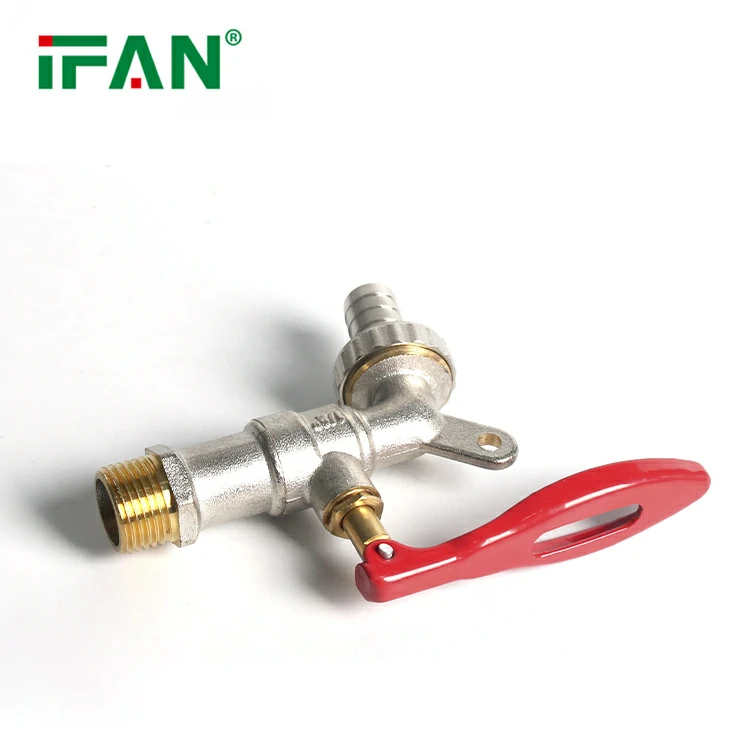
A bibcock, often referred to as a hose bib or spigot, is an outdoor faucet commonly installed on exterior walls of homes or buildings. It’s typically used for tasks like watering gardens, washing cars, or filling containers. Bibcocks have a simple design with a spout at the end, and they are usually operated by a handle or knob that opens and closes to allow water flow.
Advantages of Bibcocks:
– Easy to Use: Bibcocks are simple, manual valves that are easy to operate. They are ideal for quick and straightforward outdoor water tasks.
– Affordable: Bibcocks are generally less expensive than more complex valve systems like ball valves.
– Durable: Made from corrosion-resistant materials such as brass or stainless steel, bibcocks are built to withstand outdoor conditions.
– Frost-Proof Options: Some bibcocks are designed with internal mechanisms that prevent water from freezing in cold weather.
Disadvantages of Bibcocks:
– Less Precise Control: While easy to use, bibcocks don’t offer the same level of control over water flow as ball valves.
– Potential for Leaks: Over time, the washers or seals in bibcocks can wear out, leading to leaks or reduced functionality.
What is a Ball Valve?
A ball valve is a more advanced type of valve used to control water flow. It uses a spherical ball with a hole through the middle that rotates to open or close the valve. Ball valves are commonly used in both residential and commercial plumbing systems. They are popular for their ability to quickly shut off the flow of water with a simple 90-degree turn of the handle.
Advantages of Ball Valves:
– Precise Control: Ball valves offer more precise flow control compared to bibcocks. The ball inside can fully open or fully close with a quick turn, making it easier to regulate the water flow.
– Longer Lifespan: Ball valves are less prone to wear and tear over time, especially compared to bibcocks with rubber seals that degrade. They tend to last longer and require less maintenance.
– Leak-Proof: Since ball valves use a ball and seat design, they are generally more leak-proof compared to bibcocks, which can develop leaks in their washers.
– Versatile: Ball valves are used in a wide range of applications, from residential systems to industrial-grade plumbing.
Disadvantages of Ball Valves:
– More Expensive: Ball valves tend to be more expensive than bibcocks due to their more complex design and advanced materials.
– Installation Complexity: Installing a ball valve can be more complicated than a bibcock, especially if it involves adapting the plumbing for the specific valve.
Key Differences Between Bibcock and Ball Valve
| Feature | Bibcock | Ball Valve |
|———————-|——————————|————————————-|
| Design| Simple, spout-based design | Spherical ball with a hole inside |
| Control | Manual with knob or handle | Precise, with 90-degree turn |
| Durability | Good, but may wear out over time | Very durable, fewer maintenance needs |
| Leak Resistance | Prone to leaks over time | Highly resistant to leaks |
| Price | Inexpensive | More expensive |
| Installation | Easy installation | Requires more expertise and tools |
| Best for | General outdoor use, low-flow applications | Applications needing precise control or heavy-duty use |
Which is Better for Your Plumbing?
The choice between a bibcock and a ball valve ultimately depends on your specific plumbing needs, budget, and preferences.
1. If you need a simple, cost-effective solution for general outdoor use a bibcock is a great choice. It’s easy to install, operates with minimal effort, and provides reliable performance for most basic outdoor tasks.
2. If you need more precise control over water flow or are dealing with high-pressure systems, a ball valve would be the better option. It’s ideal for systems that require quick shut-off or long-term durability without frequent maintenance.
3. In areas with freezing temperatures, you may also want to consider a rost-proof bibcock which prevents water from freezing in the valve during cold winters, a feature not commonly found in ball valves.
Conclusion
Both bibcocks and ball valves have their own strengths and are suitable for different types of plumbing systems. Bibcocks are perfect for casual, everyday outdoor tasks, while ball valves are better suited for situations where precise control, longevity, and leak resistance are essential. Consider your specific needs before making a decision.
Frequently Asked Questions (FAQs)
1. What is the main difference between a bibcock and a ball valve?
– A bibcock is a simple valve with a spout for controlling water flow, while a ball valve uses a spherical ball to regulate water flow with more precision.
2. Can I use a ball valve outdoors?
– Yes, ball valves can be used outdoors, but they are generally more suited for controlled environments due to their higher cost and installation complexity.
3. Which is more durable, a bibcock or a ball valve?
– Ball valves are generally more durable and require less maintenance than bibcocks, which can develop leaks over time.
4. Is a bibcock frost-proof?
– Some bibcocks are frost-proof, designed to prevent freezing during winter, but not all bibcocks have this feature.
5. Can I install a ball valve myself?
– While ball valve installation is possible for DIY enthusiasts, it often requires more tools and expertise compared to installing a simple bibcock.
Related products