Why This Actually Matters for Your Piping System
Alright, let’s be honest — nobody wakes up excited about thermal expansion calculations. But here’s the thing: if you’ve ever heard a PPR pipe bang, creak, or worse, seen a joint crack after months of hot water running through it, thermal expansion is probably the culprit. And when you’re dealing with long pipe runs — say anything over 10 meters — those tiny millimeters of expansion start adding up fast.
Take PPR material specifically. Its linear expansion coefficient sits around 0.14–0.16 mm/m·°C, with most engineers using 0.15 mm/m·°C as the go-to number. Sounds like nothing, right? But run the math: a 20-meter PPR pipe carrying water at 60°C in a room that’s 20°C? That’s a 40°C difference. So:
ΔL = α × L × Δt = 0.15 × 20 × 40 = 120mm — that’s nearly 5 inches of movement!
Five inches! If your pipe is rigidly clamped at both ends with zero room to breathe, that force has to go somewhere — and it usually goes into cracking your fittings or buckling your pipe. Scary stuff, especially for large-diameter PPR pipes above DN50 where wall thickness adds rigidity and makes the material more sensitive to thermal stress.
The Real Formula You Need (And How to Use It)
Here’s the golden equation:
ΔL = α × L × (t₂ − t₁)
Where:
- ΔL = thermal expansion length (mm)
- α = linear expansion coefficient (for PPR, use 0.15 mm/m·°C)
- L = pipe length between fixed points (m)
- t₂ = maximum operating temperature of the fluid (°C)
- t₁ = installation ambient temperature (°C)
Now, PPR pipes are typically rated for 70°C continuous use and up to 95°C short-term. For residential hot water, most systems operate between 40–60°C. So if you’re installing in winter at say 5°C and your hot water hits 55°C, your Δt is 50°C.
For a 15-meter run: ΔL = 0.15 × 15 × 50 = 112.5mm
That’s over 4 inches of movement. You absolutely cannot ignore this.
What Happens If You Ignore It? The Ugly Truth
Unrestrained thermal expansion in PPR systems leads to three nightmares:
- Joint failure — Hot-melted fittings are strong, but they’re not invincible. Repeated stress cycles from expansion and contraction cause micro-cracks at the fusion zone, eventually leading to leaks.
- Pipe buckling or arching — Long straight runs without compensation will literally lift off supports, creating that annoying “knocking” sound and stressing wall penetrations.
- Support damage — Fixed anchors take enormous axial loads. One calculation showed a DN325 steel pipe with 125°C temperature difference generated over 239 tons of thrust — PPR is softer, but the principle holds.
IFAN PPR Pipes: Built to Handle Thermal Stress
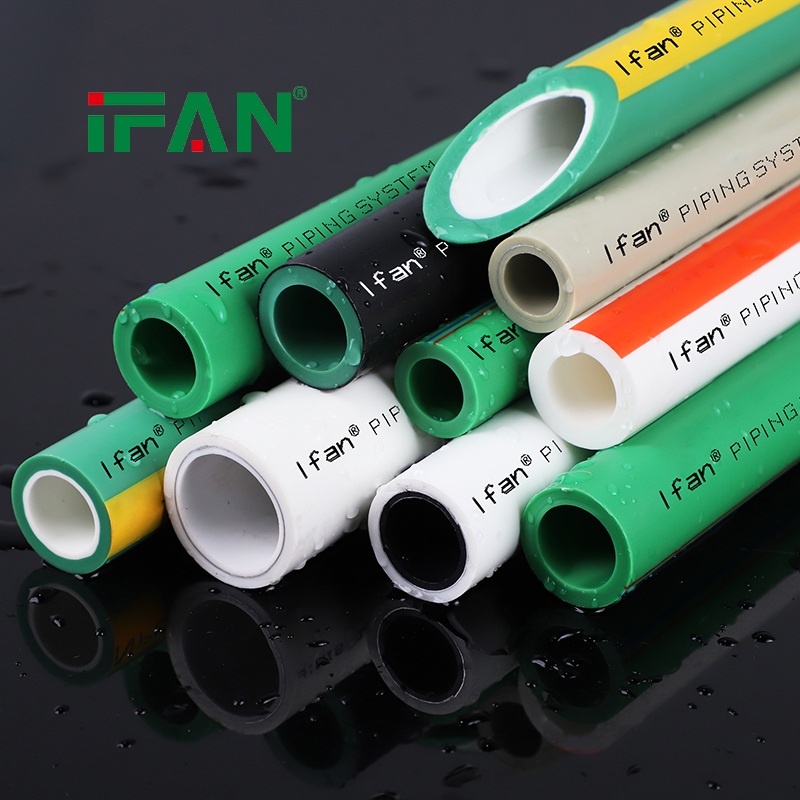
This is exactly why choosing the right product matters. IFAN PPR pipes are engineered with high-purity polypropylene raw material and stable extrusion processes that ensure consistent expansion behavior across every batch. Cheap PPR with impurities or uneven cooling? Those pipes expand unpredictably — some sections more than others — creating internal stress concentrations that premium products like IFAN simply avoid.
IFAN offers PPR piping from DN20 to DN63, covering virtually every residential and light commercial application. Their fittings — tees, elbows, reducers, crosses — all use the same high-grade material, ensuring uniform thermal response throughout your entire system. The hot-melt connection technology IFAN uses creates monolithic joints that are actually stronger than the pipe itself, giving you a fighting chance against thermal cycling.
For long runs specifically, pair IFAN PPR pipes with their full range of fittings and use sliding supports combined with fixed anchors every 3–4 meters. Let the pipe slide where it needs to, lock it where it should stay.
Quick Compensation Tricks That Actually Work
- Natural compensation first: Route your pipe in L-shapes or Z-bends. A single 90° bend can absorb significant expansion — way cheaper than expansion joints.
- IFAN PPR expansion loops: For runs over 10 meters, pre-make expansion loops using IFAN elbows. Two elbows back-to-back give you a flexible spring that handles movement elegantly.
- Sliding brackets: Use these between fixed points. IFAN’s lightweight pipes (only 1/9 the weight of steel) make bracket design simpler and cheaper.
Bottom Line
Thermal expansion isn’t optional math — it’s the difference between a piping system that lasts 50 years and one that leaks in 5. Use the formula, respect the numbers, and invest in quality materials like IFAN PPR pipes and fittings that give you consistent, predictable performance. Your future self — and your plumber — will thank you.