Why Pressure Loss Matters More Than You Think
Let’s be honest — nobody gets excited talking about pressure loss. But here’s the thing: every time you turn on a faucet and water trickles out like it’s thinking twice, that’s pressure loss doing its dirty work. In pipe systems, friction loss eats up your energy, kills your flow rate, and silently drives up your utility bills. Global studies show roughly one-third of all primary energy gets consumed by friction — that’s not a typo, it’s one-third. So understanding those charts isn’t just engineering nerd stuff; it literally saves you money.
Breaking Down the Darcy-Weisbach Equation
The go-to formula for calculating friction loss in pipes is the Darcy-Weisbach equation:
Hf = f × (L/D) × (V²/2g)
Sounds scary? Let me decode it. “Hf” is your head loss — how much energy the water loses pushing through the pipe. “f” is the friction factor, which depends on how rough the pipe wall is and how fast water moves. “L” is pipe length, “D” is diameter, “V” is flow velocity, and “g” is gravity.
Here’s the kicker — pressure loss is inversely proportional to the fourth power of diameter. Shrink your pipe by half? Loss jumps 16 times. That’s why sizing matters so much. Also, double your flow rate, and friction loss quadruples. Wild, right?
What the Charts Actually Tell You
Friction loss charts for PPR pipes typically show you meters of head loss per 100 meters of straight pipe at different flow rates and diameters. For example, a 100mm PPR pipe carrying 8 L/S might show roughly 1.3 meters of loss per 100 meters — that’s for new pipe. Old or fouled pipe? Double it.
The Reynolds number tells you what kind of flow you’re dealing with. Below 2300? Smooth laminar flow. Above 4000? Turbulent chaos. Between those numbers? Transition zone — unpredictable. Most real-world plumbing sits in turbulent territory, which is why friction factor charts become your best friend.
The Secret Weapon: IFAN PPR Pipes
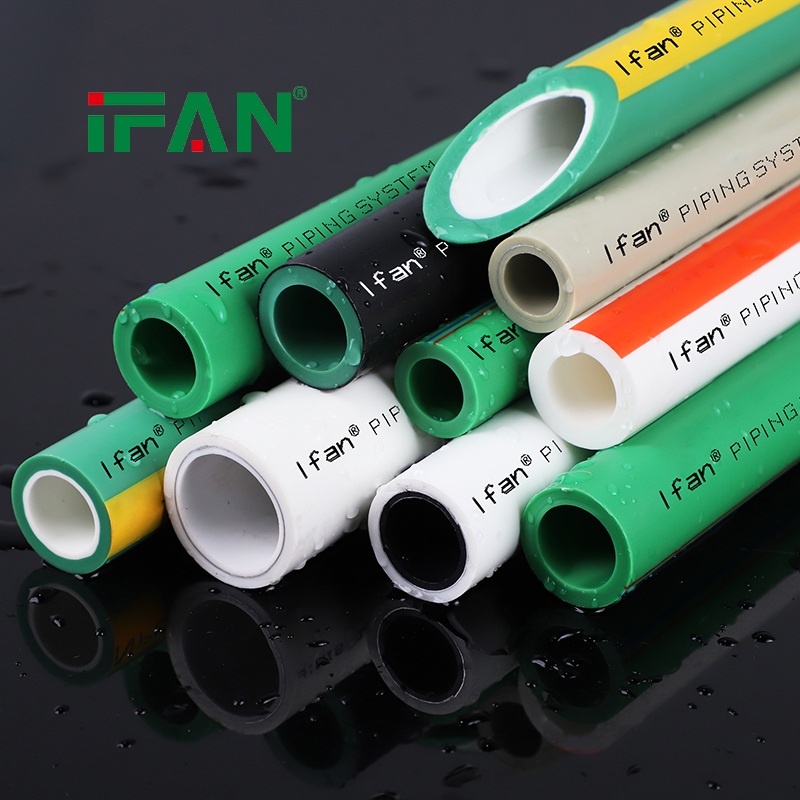
Now here’s where it gets interesting — not all pipes are created equal. IFAN PPR pipes have a seriously smooth inner wall. Why does that matter? Because friction loss is directly tied to wall roughness. Smoother wall means lower friction coefficient “f” in that equation, which means less energy wasted. In practical terms, IFAN PPR pipes deliver more flow at lower pressure compared to traditional metal or PVC pipes.
IFAN uses premium random copolymer polypropylene — food-grade, non-toxic, built to last 50+ years. The (smooth interior with minimal resistance) isn’t just marketing talk; it’s physics. Less scaling, less bacterial growth, and your pump doesn’t have to work overtime. For HVAC water systems, industrial process water, or residential plumbing, IFAN PPR fittings — elbows, tees, valves — all maintain that low-friction advantage.
Their hot-fusion connections create seamless joints with zero leakage risk. No gaskets, no threading issues — just one solid pipe run. That eliminates local resistance losses at connection points, which in older systems can account for 30-50% of total losses.
Don’t Forget Local Losses — Fittings Are Killers
Charts usually cover straight pipe only. But real systems have elbows, tees, valves, reducers. Each fitting adds equivalent length — like a standard 90° elbow equals roughly 25 pipe diameters of extra straight pipe. A bottom valve? That’s 100 times the diameter. So a 100mm bottom valve acts like 10 meters of extra pipe.
IFAN’s full range of fittings — from 20mm to 63mm — are designed with optimized flow paths that minimize turbulence. Their ball valves, when fully open, add far less resistance than cheap alternatives. Pair that with IFAN’s smooth-bore design, and your total system loss drops significantly.
Bottom Line: Pick Smart, Save Big
Pressure loss charts are your roadmap. But the pipe you choose determines whether you’re driving on a smooth highway or a bumpy dirt road. IFAN PPR pipes give you the smoothest ride — lower friction, less energy waste, cleaner water, and decades of trouble-free service. Whether you’re designing a commercial chiller system or outfitting a family home, start with the right pipe. Your water bill — and your plumber — will thank you.
Go with IFAN. It’s not just a pipe; it’s the invisible force keeping your system efficient, quiet, and reliable for half a century.