PEX Press Fittings vs Crimp Fittings: Which Connection Actually Holds Up Better?
Let’s Settle This Once and For All
If you’ve ever stood in a plumbing supply aisle staring at PEX fittings, you know the headache. Press or crimp? The internet is full of opinions, but very few people actually tell you the truth. So here it is — no fluff, no marketing speak, just the facts from someone who’s seen both methods fail and succeed in the real world.
Crimp fittings use a copper or stainless steel ring that you slide over the PEX tube, then squeeze shut with a crimping tool. Simple. Cheap. Brutally effective.
Press fittings use a pre-installed stainless steel collet. You expand the tube with a press tool, slide the fitting in, and let the tube shrink back around it. Sounds fancy, right? But does fancy mean better?
Reliability Showdown: Crimp Wins, and It’s Not Even Close
Here’s something the press fitting crowd doesn’t want you to hear: copper crimp rings deliver what industry veterans call “Mercedes-level engineering for the price of a bicycle.” Once that copper ring is properly crimped onto a PEX-B or PEX-C tube, you get a physical lock that basically never fails. We’re talking connections that will never leak — not in five years, not in twenty years.
Press fittings are solid, sure. But they rely on brass fittings, and brass — even lead-free brass — can corrode over time, especially in areas with acidic or hard water. IFAN PEX press fittings use CW617N lead-free brass with excellent corrosion resistance, but let’s be honest: a copper crimp ring doesn’t corrode. It’s copper. It just sits there and does its job forever.
So if raw reliability is your number one priority, crimp with copper rings takes the crown. No debate.
Speed and Ease of Use: Press Fittings Have the Edge
Where crimp falls short is speed. You’ve got to position the ring, align the fitting, and crimp it carefully. In tight spaces — behind a wall, inside a crawl space — crimping tools can be a nightmare to maneuver.
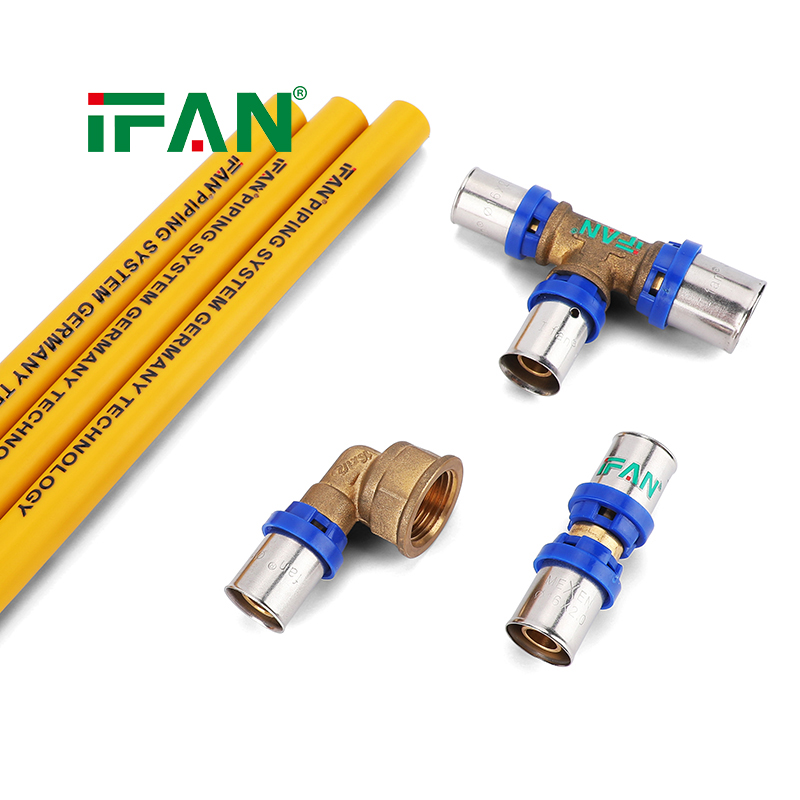
Press fittings? Slide the collet, press the tool, done. Three seconds. No open flame, no angle juggling, and the tools are lighter and easier to carry all day. IFAN PEX press fittings come with the collet pre-installed, which saves you an entire step on-site. For contractors racing against deadlines, that time savings adds up fast.
Match the Fitting to Your Pipe Type — That’s the Real Secret
Here’s where most people get it wrong: they pick a fitting based on hype instead of pipe type.
Crimp fittings are the king of PEX-B and PEX-C tubing — which is what most residential installations use. Copper rings on these pipes create a bond that’s virtually indestructible.
Press fittings shine with PEX-A tubing, thanks to its thermal memory. The tube expands, you insert the fitting, and as it shrinks back, it grips like a vice. Press fittings also work with PEX-B and PEX-C, giving you more versatility.
IFAN manufactures both types, backed by over 30 years of production experience. Every single fitting — crimp or press — goes through air pressure and hydrostatic testing before it ships. ISO and EN standard compliant. Need copper crimp fittings for a residential job? IFAN has you covered. Need press fittings for a commercial PEX-A system? IFAN delivers that too.
The Bottom Line: Stop Overthinking It
Don’t let the word “premium” fool you into thinking press fittings are automatically better. Crimp fittings with copper rings have been proven across millions of homes worldwide for decades. They’re cheaper, more durable long-term, and just as reliable.
Press fittings are faster and more versatile, but they cost more — both in tools and in the fittings themselves — and the brass material introduces a corrosion variable that crimp simply doesn’t have.
IFAN delivers top-tier quality in both categories. Free samples available, 7 to 15 day shipping, and full OEM customization if you need it. Pick the right fitting for your pipe type, and your plumbing system will run leak-free for 50 years. That’s not a marketing claim — that’s what three decades of manufacturing excellence gets you.