IFAN PEX Press vs Compression Fittings: Which One Should You Actually Pick?
The Short Answer: Press Fittings Win in Almost Every Scenario
If you’ve ever installed underfloor heating or rerouted water lines, you know there are really only two ways to connect PEX pipe — Press (crimp) or Compression. A lot of people swear by compression fittings because “you can take them apart and fix things later.” Sounds logical. But in real-world use, IFAN’s Press fittings are just better in nearly every way.
Let’s break it down using IFAN’s own product lines.
Leak Resistance: Press Wins, No Contest
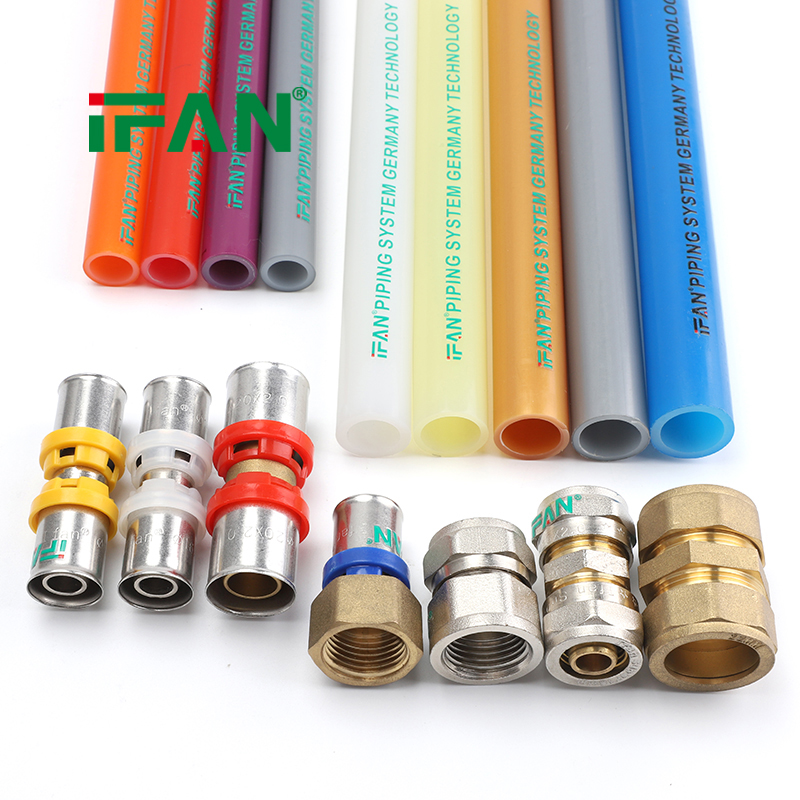
IFAN’s Press fittings use a dual O-ring design — an inner seal plus an outer seal. The press tool creates a hexagonal crimp that locks the fitting onto the pipe permanently. It meets the strictest European standards, and you can pressurize the system immediately. No waiting.
Compression fittings rely on a copper ferrule that you tighten by hand. The seal depends entirely on how hard you turn the nut. Too loose and it leaks. Too tight and you deform the pipe. IFAN’s compression fittings use corrosion-resistant brass and are built tough, but the mechanical clamping principle means the ferrule can loosen slightly over time under heat. That’s just how the design works — you can’t engineer around it.
Bottom line: Press is “crimped and done forever.” Compression is “tightened and maybe.”
Installation Speed: Press Is Twice as Fast
IFAN Press fittings work with battery-powered crimp tools. Align, crimp, done — three seconds per joint. No heat, no cooling time, no wrenches. A skilled installer can knock out 200 joints in a day.
Compression? Every joint needs a wrench. PEX is flexible, so while you’re turning the nut the pipe wants to spin. You end up holding it steady with one hand and cranking with the other. One joint takes at least a minute. On a full underfloor heating system, that’s two to three extra hours of labor.
One detail IFAN nailed on the Press side: the guide section prevents the pipe from scratching the O-ring during insertion. That small feature directly determines how long the seal lasts. Compression fittings don’t have this — it’s all on your hand steadiness.
The One Thing Compression Does Better: It’s Removable
Fair play — compression fittings can be unscrewed. If you need to swap a valve or reroute a line later, you just loosen the nut and pull it apart. Press is permanent. You want to change it, you cut the pipe and start over.
But think about it: underfloor heating pipes are buried under concrete. You’re installing them once in a lifetime. Who’s actually going back in there to disassemble joints? For the rare spots where you do need removable connections — pump rooms, equipment rooms — IFAN makes union fittings. You don’t need compression for that.
Pull-Out Strength and Longevity: Press Destroys Compression
IFAN Press fittings with their dual O-ring and stainless steel clamp rings have significantly higher tensile strength than single-seal compression fittings. PEX expands and contracts a lot — floor temps swing from 20°C to 60°C. Over decades, that movement puts constant stress on every joint. The hexagonal crimp on Press fittings handles that stress without breaking a sweat.
Compression ferrules lose bite force over time as the metal fatigues from thermal cycling. Fine for five years. Risky after ten.
Material Quality: IFAN Keeps It Solid on Both Lines
Whether Press or Compression, IFAN uses low-lead brass — 58-3 copper or CW617 copper — with full CE and ISO certification. Press fittings are rated PN25, compression fittings PN16. Both are overkill for residential underfloor heating.
Final word: if you’re on the fence, go IFAN Press. Faster, tighter, leak-proof, and built for fifty years. Save compression fittings for the few spots where you genuinely need to take things apart.