IFAN HDPE Butt Fusion vs Electrofusion Fittings: Which One Actually Fits Your Job?
Let’s Be Honest: Neither Is “Better.” Only One Is Right for Your Site.
Anyone who’s worked with HDPE piping knows there are only two fusion methods — Butt Fusion and Electrofusion. People argue about which is stronger every day, but it’s like asking “car or subway?” — depends on where you’re going.
Let’s break down IFAN’s own product lines and make it crystal clear.
Butt Fusion: The King of Large Diameters
The principle is simple: a heating plate brings both pipe ends to around 210°C, you remove the plate, push them together under pressure, and let it cool. One solid piece.
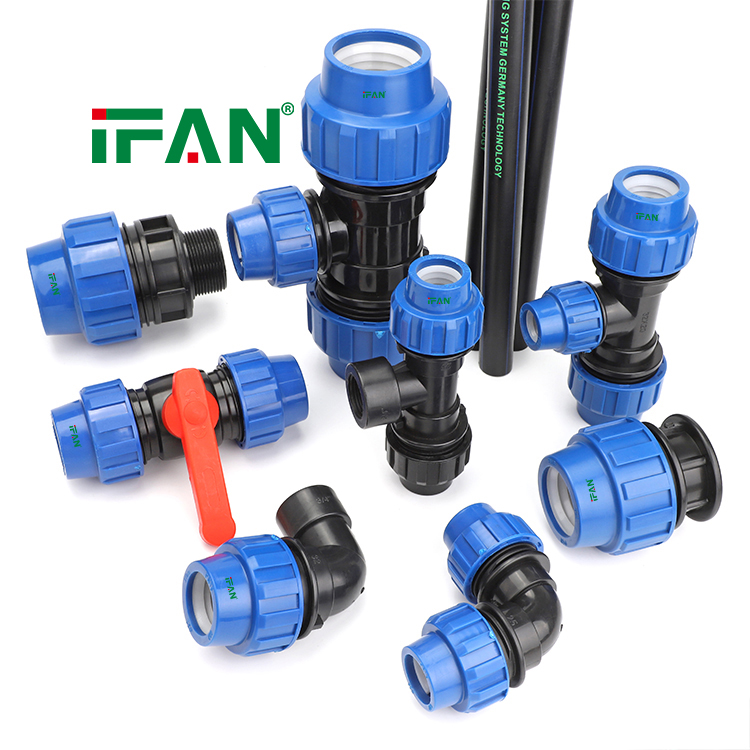
IFAN’s Butt Fusion fittings are made from PE100 material, covering SDR11 and SDR17 pressure ratings, sizes from 63mm all the way to 1200mm. This is the go-to for municipal water mains, gas trunk lines, and large-scale agricultural irrigation.
The biggest advantage? Joint strength equals the pipe itself. The connection isn’t a weak point — it’s as strong as the pipe. And it’s cheaper. A 90° elbow in butt fusion costs significantly less than its electrofusion equivalent.
The downside: you need a butt fusion machine, and everything depends on the operator’s skill. Temperature, time, pressure — get one wrong and the joint fails. And below 63mm, there’s barely enough room to work.
Electrofusion: The Lifesaver for Small Pipes and Tight Spaces
Electrofusion works completely differently. The fitting has built-in heating wires. You insert the pipe, apply voltage, the wires melt the contact surface, and it fuses on its own.
IFAN’s Electrofusion fittings cover 20mm to 400mm, PN16 rating, black body with embedded heating elements. The killer feature — it doesn’t depend on human skill. You set the voltage and time on the machine, hit the button, and every joint comes out identical.
That means narrow trenches, underground vaults, saddle connections on live pipes — electrofusion is often the only realistic option. For small-diameter pipes (20mm to 63mm), it’s multiple times faster than butt fusion.
The catch? It costs more. Electrofusion fittings run 30–50% higher than butt fusion, and you need a dedicated electrofusion machine too.
Quick Comparison Table
| Factor | IFAN Butt Fusion | IFAN Electrofusion |
|---|---|---|
| Pipe Size | ≥63mm, up to 1200mm | 20mm–400mm full range |
| Joint Strength | Equals pipe body | Equals pipe body |
| Skill Required | High — operator-dependent | Low — machine-controlled |
| Cost | Lower fitting cost, mid-range equipment | Higher fitting cost, expensive equipment |
| Small Diameter | Poor — not enough workspace | Excellent — built for it |
| Complex Fittings (tees/saddles) | Difficult | Effortless |
| Best For | Municipal mains, large irrigation | Branch connections, repairs, tight spaces |
Same Quality Standard Across Both Lines
Whether you pick Butt Fusion or Electrofusion, IFAN uses 100% virgin PE100 material — zero recycled content. Both lines are certified to ISO 4427, ISO 4437, EN 12201, and EN 1555. They export to over 60 countries across Europe, the Middle East, and South America, with full CE and EAC compliance.
IFAN has been operating from Zhuji, Zhejiang since 2001 — over two decades, $36M+ in annual exports. Many of the HDPE projects you see overseas are running IFAN fittings underground right now.
OEM available with a 20,000-piece minimum. If you’re running a project and need compliance documentation, IFAN’s factory provides full test data with every batch.
Bottom line: large pipes, tight budget, experienced crew — go IFAN Butt Fusion. Small pipes, complex layouts, consistent quality — go IFAN Electrofusion. Stop overthinking it. Match the fitting to the job.