
IFAN HDPE Fittings Pressure Ratings and DN Sizing Guide: Pick the Right Rating or Pay for It Later
The #1 Mistake with HDPE Fittings: Wrong Pressure Rating
Anyone who’s worked on municipal water or farm irrigation knows the drill — get the pressure rating wrong, and you’re looking at leaks or worse, burst pipes. IFAN manufactures HDPE fittings from DN20 all the way to DN1200, but every size comes with different pressure capabilities. Let me break down the whole selection logic so you never have to guess again.
Pressure Ratings: PN and SDR Are the Same Thing
When you see PN16, PN10, PN12.5 — those numbers tie directly to SDR (Standard Dimension Ratio). The formula is simple: SDR = Outside Diameter ÷ Wall Thickness. Lower SDR means thicker wall, higher pressure rating.
IFAN uses PE100 material for all HDPE fittings. Here’s the pressure-to-SDR mapping you need to memorize:
| Pressure Rating | SDR | Wall Thickness (DN110 example) | Best For |
|---|---|---|---|
| PN6 | SDR26 | 4.2mm | Low-pressure irrigation, drainage |
| PN8 | SDR21 | 5.3mm | Farm irrigation, landscape water |
| PN10 | SDR17 | 6.6mm | Municipal water mains |
| PN12.5 | SDR13.6 | 8.1mm | City water supply, industrial transfer |
| PN16 | SDR11 | 10.0mm | High-pressure mains, long-distance transfer |
| PN20 | SDR9 | 12.2mm | Special high-pressure applications |
Quick rule: residential irrigation goes PN8 to PN10, municipal water needs at least PN12.5, main lines should be PN16. IFAN’s PN16 and PN10 series are their highest-volume products — always in stock, fast delivery.
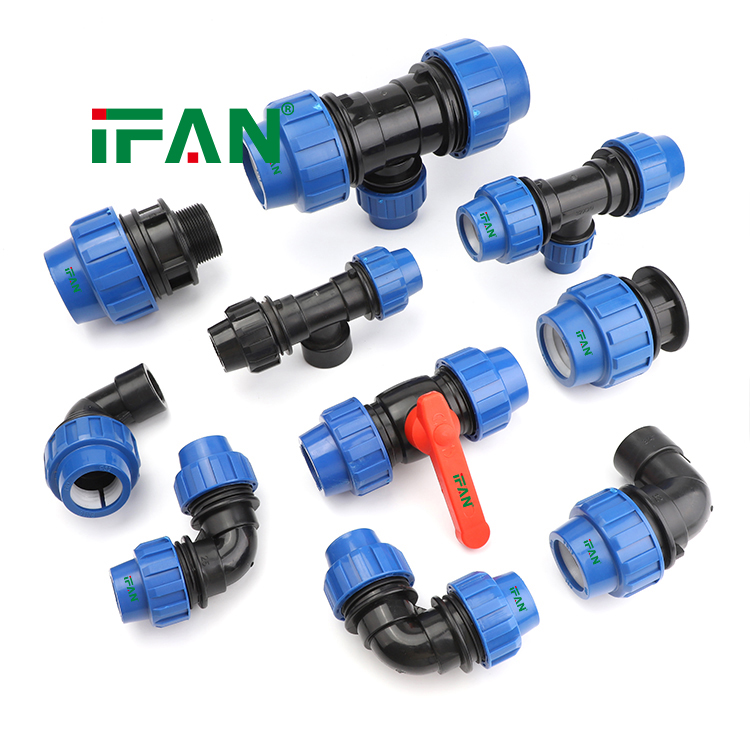
DN Sizing: From 20mm to 1200mm, Full Coverage
IFAN covers DN20 through DN1200, but not every size gets every pressure rating. Small diameters (DN20–DN90) are available across all ratings. Large diameters (DN315+) typically only come in PN10 and PN16.
Here’s your quick-pick guide:
- DN20–DN63: Home connections, drip irrigation. PN10 or PN12.5 is plenty. IFAN’s socket fittings in this range are their strongest product — push-fit with O-ring seal, no heat gun needed.
- DN75–DN160: Community mains, factory water supply. Go PN16. IFAN’s electrofusion fittings are most complete here — elbows, tees, reducers all in stock.
- DN200–DN400: Municipal trunk lines. PN16 minimum. IFAN offers flange-adapted fittings that bolt directly to carbon steel flanges, saving massive installation time.
- DN450–DN1200: Long-distance transfer, drainage. PN10 or PN8 works fine — large diameters have naturally thick walls, so pressure demand is lower.
Temperature Kills Pressure — Most People Ignore This
PE100 handles PN16 at 20°C. But the moment water temperature climbs, the allowable pressure drops. IFAN’s technical data includes derating coefficients. Here are the key numbers:
| Water Temp | Derating Factor | PN16 Effective Pressure |
|---|---|---|
| 20°C | 1.0 | 16 bar |
| 30°C | 0.8 | 12.8 bar |
| 40°C | 0.7 | 11.2 bar |
| 50°C | 0.6 | 9.6 bar |
If your system carries hot water, don’t force PN16 — either step up a rating or derate accordingly. IFAN rates all fittings at 20°C. The temperature correction is your responsibility, and it’s non-negotiable.
Which Connection Method Does IFAN Offer?
IFAN’s HDPE fittings come in three connection types: socket, electrofusion, and butt fusion. For DN20 to DN110, socket is the fastest — push the pipe in, O-ring seals it, no electricity or flame required. DN160 and above almost always use electrofusion or butt fusion. IFAN’s electrofusion fittings have built-in heating wires — plug in the control box, and the joint fuses into one solid piece with the pipe. Fifty-year lifespan, zero leak risk.
Picking the right fitting boils down to three steps: set your pressure, set your diameter, pick your connection. IFAN covers PN6 through PN20, DN20 through DN1200. Use this guide, and you’ll get it right the first time.





