How Brass Ball Valves Control Flow in Plumbing Systems: IFAN Breaks It Down for You
One: The Principle Behind Ball Valve Flow Control — It’s Actually Dead Simple
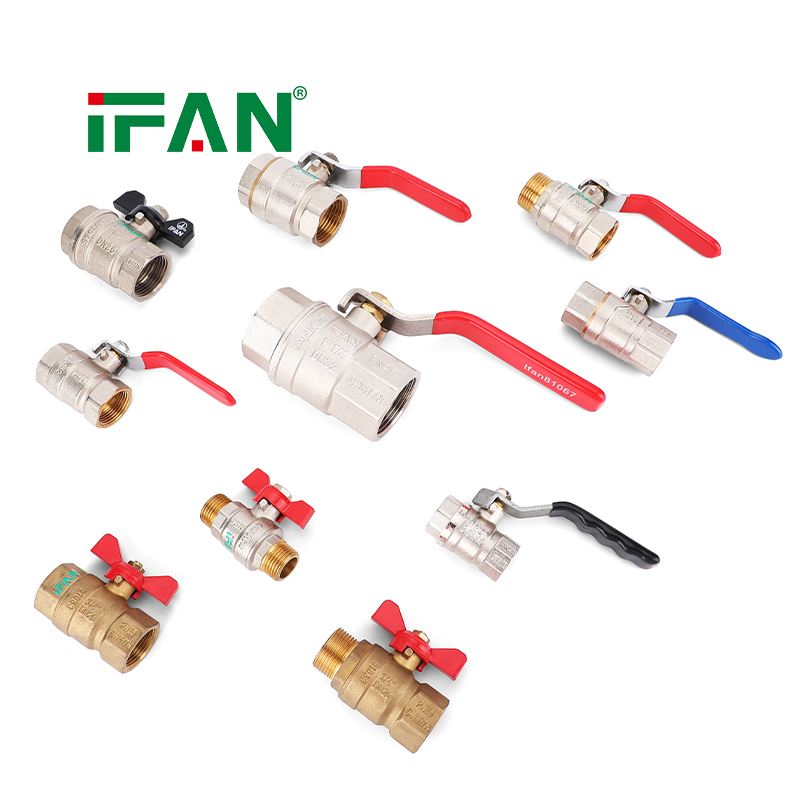
Most people use ball valves every single day, but ask them how it actually controls water flow, and nine out of ten will stare at you blankly. Here’s the truth — inside a ball valve, there’s a metal ball with a hole drilled through the center. Turn the handle 90 degrees, the hole lines up with the pipe, water flows freely. Turn it another 90 degrees, the solid part of the ball blocks the pipe, and water stops completely.
That’s it. That’s the whole thing.
But simple doesn’t mean easy to make well. IFAN Brass Ball Valves sell like crazy around the world because they’ve taken this “simple” concept and perfected every single detail — ball core precision, seal material, handle torque. Miss by even a little, and the whole experience falls apart.
Two: How Does IFAN Achieve Precise Flow Control?
It all starts with the ball core.
IFAN uses a high-precision brass ball core with a mirror-polished finish. You might think polishing is just for looks — it’s not. The smoother the ball core, the less resistance the water faces, and the less flow you lose. IFAN’s full-bore ball valve has a ball channel that matches the pipe’s inner diameter exactly. When water flows through, you barely feel like there’s a valve there at all.
Cheap valves? Their ball channel is smaller than the pipe. Water going through feels like squeezing a garden hose — pressure drops like crazy. Your home water pressure is already low, then you add a reduced-bore valve, and suddenly your showerhead is weeping instead of flowing. Annoying, right?
Sealing is done with PTFE seats.
IFAN doesn’t use metal-on-metal sealing — that wears out after a few cycles. Instead, they use PTFE (polytetrafluoroethylene) seats. It’s a soft seal design. When the ball closes, it presses directly against the PTFE with zero gap. What does that mean? It means when you shut the valve, not a single drop leaks through. And because it’s soft contact, you can open and close it tens of thousands of times without wearing down the seat. That’s real durability.
Handle torque makes or breaks the experience.
IFAN’s handle is ergonomically designed — smooth to open, smooth to close. No awkward halfway stuck moments. Some ball valves have handles so stiff that women can’t turn them, let alone elderly people. IFAN’s handle turns effortlessly with one hand. No struggle, no frustration.
Three: How Does IFAN Perform at Different Opening Positions?
This is where ball valves really shine — they’re not just “on” and “off.” Any angle in between gives you precise flow control.
Fully open: Handle parallel to the pipe, ball hole fully aligned, max flow. IFAN’s full-bore design loses less than 3% of flow at this position — basically nothing.
Half open: Handle at 45 degrees, ball hole half exposed, flow drops by roughly 50%. This is perfect for water temperature adjustment — install an IFAN ball valve on your water heater outlet, crack it half open, flow drops, temperature rises. No need to keep adjusting the heater itself.
Slightly open: Handle barely turned, just a thin slit of water coming through. Great for draining residual water from pipes, or keeping a trickle flowing in winter to prevent freezing. IFAN’s PTFE seal still holds zero leaks even in this position — something most cheap valves simply can’t do.
Fully closed: Handle perpendicular to the pipe, solid ball completely blocking the passage, zero flow. IFAN’s full-close seal meets zero-leakage standards. Doesn’t matter how high your water pressure is — shut is shut.
Four: Why Must Your Plumbing System Use IFAN Brass Ball Valves?
Let’s be honest — for flow control in piping systems, ball valves are the best all-around option. Better seal than butterfly valves, faster operation than gate valves, higher flow than globe valves. And IFAN’s brass ball valves sit at the very top of this category.
H59 brass body resists corrosion and handles high pressure. NPT threaded connections seal reliably. Full-bore design means zero flow loss. PTFE soft seals last forever. Whether it’s your home renovation or a factory project, if you need flow control, go with IFAN. That money is well spent.
IFAN offers free samples, delivers in 7 to 15 days, and is trusted in over 100 countries worldwide. Stop guessing. For flow control, trust IFAN Brass Ball Valves — they get it right every time.