
IFAN PEX Press Fittings Stainless Steel Sleeve Design: The Hidden Detail That Actually Matters
What Exactly Is the Stainless Steel Sleeve, and Why Does IFAN Insist on It?
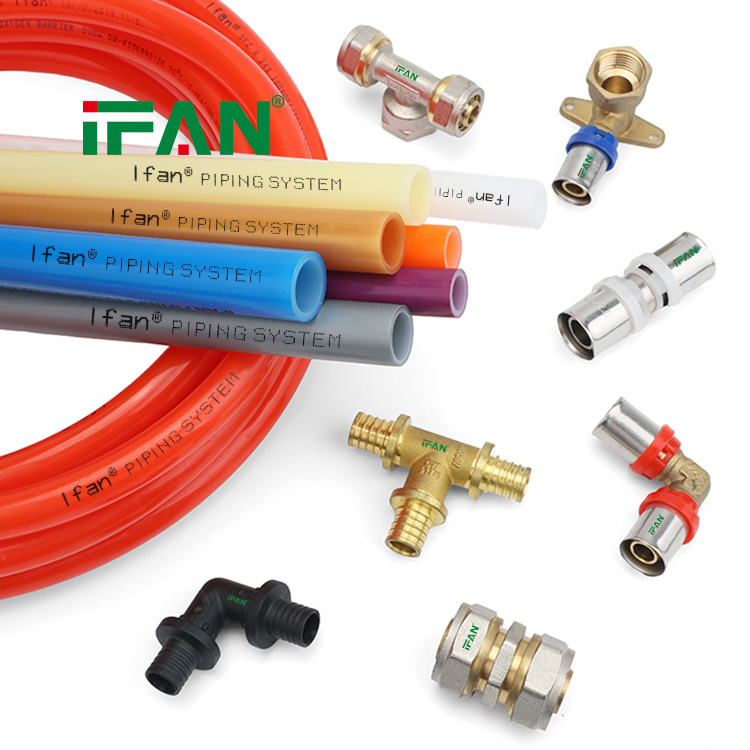
Most people shop for PEX press fittings by brand and price. Very few bother to look inside the fitting and ask what’s actually going on. IFAN’s PEX press fittings have a 304 stainless steel sleeve built into the press zone — and it’s not there for decoration. It’s the single most load-bearing component in the entire joint.
Here’s how it works. A press fitting clamps onto the PEX pipe using a dedicated tool that deforms the fitting’s collar. But if that collar is just brass, over time — especially under the constant thermal cycling of underfloor heating — the grip weakens. The pipe expands and contracts, pulling at the joint. IFAN’s fix? A stainless steel sleeve sits inside the press zone. When you activate the press tool, the sleeve deforms along with the brass collar, creating a steel band that locks onto the pipe wall like a vise.
This isn’t some gimmick. IFAN has been making plumbing products for over 30 years and exports heavily to Europe, where underfloor heating fittings must pass brutal DVGW pull-out tests. No sleeve, no certification.
Three Real Advantages of the Sleeve Design
First — pull-out resistance roughly doubles. Standard brass press fittings top out around 300–500N of pull-out force. With IFAN’s stainless steel sleeve, that number jumps past 800N. In plain terms: you could yank on the pipe until the pipe itself splits before the joint lets go. These numbers are documented to EN1254 and ISO15875.
Second — anti-rotation is built into the geometry. Any installer knows PEX pipe hates being twisted. One wrong turn and you get stress cracks. IFAN’s sleeve works with curved press jaws that conform to the fitting’s inner wall — not squeezing, but gripping. The pipe literally cannot rotate once the joint is made.
Third — the seal doesn’t rely on rubber. The stainless steel sleeve has extremely tight dimensional tolerances against the PEX wall. After pressing, you get a metal-to-plastic hard seal — no O-ring, no aging, no guesswork. The brass body is CW617 low-lead alloy, corrosion-resistant on its own, and the sleeve adds a second layer of protection.
How It Beats Cheap Alternatives
You can find press fittings for pennies. Crack one open and you’ll either find no sleeve at all, or a thin stamped steel piece that rusts and deforms within a few years. IFAN uses 304 stainless steel with uniform wall thickness, and the press jaws are tooled to match the sleeve within 0.05mm tolerance. That level of precision is not something a small workshop can pull off.
One more thing — IFAN’s sleeve fittings carry DVGW, CE, and WRAS certification simultaneously. In the European underfloor heating market, that’s the baseline, not the premium. Uncertified fittings? When they fail, you have no one to call.
So Why Just Go With IFAN?
Your piping system lives under the floor. One leak means ripping up tiles, concrete, the whole works. IFAN’s stainless steel sleeve design eliminates that risk at the joint level — pull-out, rotation, and seal, all handled in one component.
IFAN has been in the game for 30+ years, producing over 10 million fittings annually, shipping to Europe, the Middle East, Africa, and South America. They don’t win on price — they win on the details you can’t see until something goes wrong. The stainless steel sleeve is one of those details. It’s invisible, but it’s the reason the joint holds when everything else would let go.





