PTFE Seals and Their Role in Brass Ball Valve Leak Prevention: How IFAN Nails It
When a ball valve starts leaking, most people blame the valve itself. But here’s the thing — the real culprit is often something you can’t even see: the PTFE seal.
Today let’s dig into this tiny “behind-the-scenes hero” and talk about how IFAN Brass Ball Valves use PTFE seals to shut down leaks for good.
What Exactly Is PTFE and Why Does Every Ball Valve Use It?
PTFE stands for polytetrafluoroethylene — basically what most people call Teflon. This material is ridiculously good at what it does. It has the lowest friction coefficient of any solid material on the planet — even slipperier than ice. It handles temperatures from -196°C all the way up to 260°C, and virtually no chemical can corrode it.
Think about what happens inside a ball valve every time you open or close it. The ball rubs against the seat, over and over. If the seal material is cheap, it wears down fast, grooves form, and water starts sneaking through. But PTFE? It barely wears at all. You can cycle it tens of thousands of times and the sealing surface stays perfectly flat.
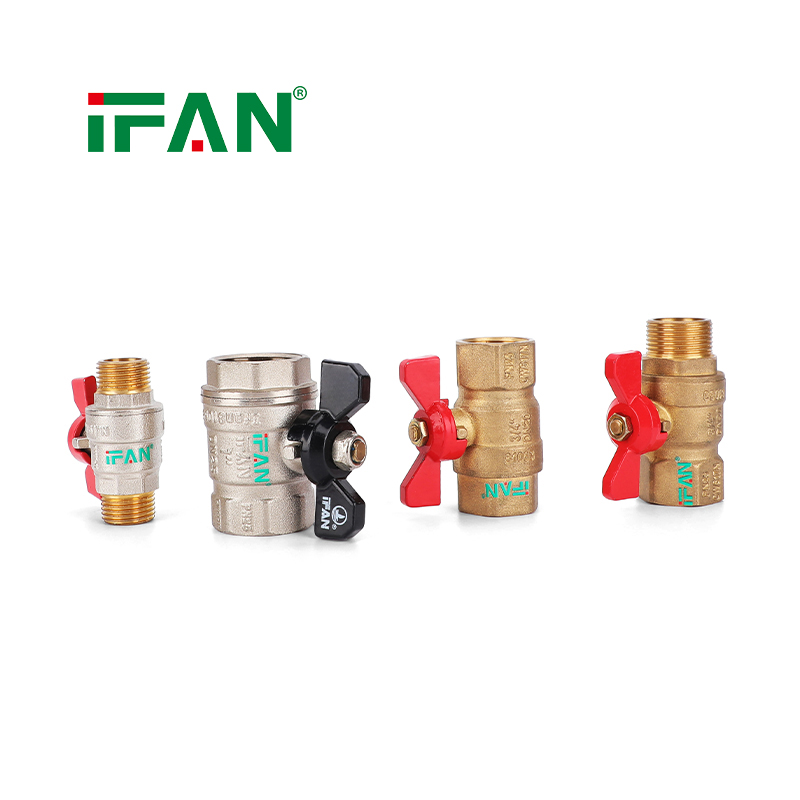
That’s why every decent ball valve — whether it’s for your home or an industrial pipeline — uses PTFE for the seat seal. IFAN uses high-purity PTFE in all their brass ball valves, not some cheap filled version. The real deal.
How Does PTFE Actually Prevent Leaks Inside a Ball Valve?
Let’s crack open a ball valve and see what’s going on. Inside, there’s a ball with a hole in the middle — water flows through that hole. Around the ball sits a seat, and wrapped around that seat is the PTFE seal ring.
When you turn the valve shut, the ball gets pressed tight against the seat, and the PTFE seal compresses and deforms to completely fill every gap between the ball and the seat. No matter how high the water pressure gets, there’s nowhere for it to escape.
Now here’s where rubber seals fail — they age, harden, crack, and once they crack, you’ve got a leak. PTFE doesn’t do any of that. IFAN’s PTFE seals maintain their shape even under long-term hot water exposure, even when your water heater is running at 70-80°C every single day.
And there’s a bonus — PTFE is self-lubricating. Every time you operate an IFAN ball valve, the PTFE surface creates an ultra-thin lubricating film. That’s why the handle feels so smooth — no sticking, no grinding. Once you feel it, you can’t go back.
What Makes IFAN’s PTFE Seals Different From Everyone Else’s?
A lot of valves out there say “PTFE seal” on the box, but you crack them open and the seal ring is paper-thin — squeeze it and it just collapses. Those might hold up for a while, but after a year or so, game over.
IFAN uses a thickened PTFE seat seal design — the wall thickness is over 30% thicker than standard products. What does that mean in real life? Better compression and rebound. Even if the valve body shifts slightly due to temperature changes, the PTFE seal automatically compensates and keeps the seal tight.
On top of that, IFAN machines their PTFE seals to a surface flatness of within 0.02mm. When the ball presses down, the contact area is virtually 100% — no weak spots, no partial gaps. And don’t underestimate tiny leaks. A slow drip adds up to serious water waste over time.
In Piping Systems, How Critical Are PTFE Seals Really?
Let’s do some quick math. A typical home plumbing system has at least a dozen valves — kitchen, bathroom, water heater, underfloor heating manifold. If even one of those valves has a bad seal and drips slowly, the wasted water plus repair costs over a year could buy you several sets of IFAN ball valves.
In municipal and commercial systems, it’s even worse. Hotels, hospitals, schools — hundreds or thousands of valves running 24/7. The reliability of PTFE seals directly determines the operating cost of the entire piping system.
That’s exactly why IFAN insists on using high-purity, thickened PTFE seals in every single brass ball valve they make — it’s not about looking premium, it’s about saving you money.
The Bottom Line: When Buying a Ball Valve, Check the Seal First
Next time you’re shopping for a ball valve, don’t just look at whether the body is brass or if the handle looks nice. Ask the seller: What seal material do you use? How pure is the PTFE? How thick is the seal ring?
If they can’t answer those questions, walk away. Just go with IFAN Brass Ball Valve — the PTFE seal quality speaks for itself. Once you install it, the only thing you’ll need to do is forget it’s there, because it simply won’t cause you any trouble.