Is Your Underground Pipe Slowly Getting Crushed Right Under Your Feet?
Look, most people spend weeks picking tile colors and countertop materials during renovation. Then they throw some pipes in the ground, cover them up, and forget about them. Three years later — bathroom leaking, kitchen damp, water bill through the roof. You tear up the floor and guess what? The pipe got squished flat like a pancake.
Nobody thought about stiffness when they bought it. That’s the real problem.
Today let’s talk about why stiffness actually matters more than pressure rating for buried pipes — and why I keep pointing people toward IFAN’s PPR pipe system for anything going underground.
Stiffness Class — What It Actually Means in Plain English
Forget the textbook definitions for a second. Stiffness class on a PPR pipe basically tells you one thing: can this pipe hold its round shape when stuff pushes on it from the outside?
Two numbers control this. First is SDR — Standard Dimension Ratio. Think of it like how chubby the pipe is. SDR 11? Skinny pipe, thin walls, fine for cold water inside a wall. SDR 6? Fat pipe, thick walls, built to take a beating underground. Lower SDR means thicker wall means stiffer.
Second is MRS — Minimum Required Strength. This is about the raw material itself. Good PPR resin hits 20 MPa MRS or higher. Cheap recycled stuff sits around 14–16 MPa. The difference sounds small on paper, but when you divide MRS by the safety factor to get working pressure, that 6 MPa gap becomes huge.
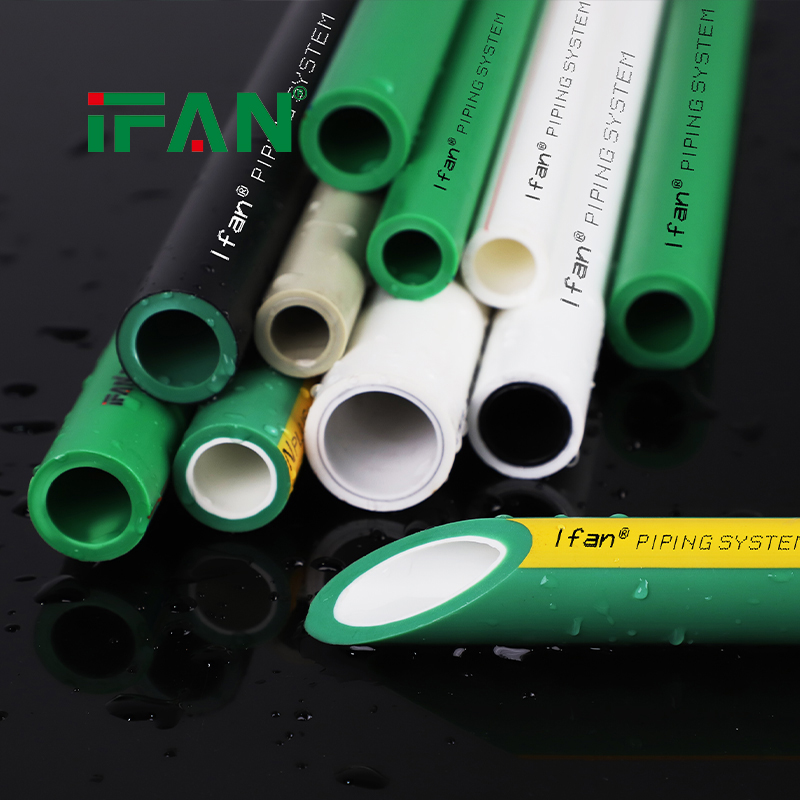
IFAN uses virgin PP-R Type 3 resin with MRS consistently above 20 MPa across their entire product line. And they cover every SDR from 17 down to 5. Want buried pipe? Grab SDR 6 or SDR 5. Their dn25 hot water pipe hits 4.2mm wall thickness — that’s a full 20% thicker than the national standard minimum of 3.5mm. That extra metal isn’t marketing, it’s survival gear underground.
What’s Actually Pushing on Your Buried Pipe
People think “buried pipe, it’s just dirt on top, no big deal.” Nah.
Dead load first. Every meter of soil adds roughly 18–20 kPa. At 1.5 meters deep you’re already looking at 30 kPa sitting on that pipe — that’s about 300 kilograms per square meter pushing down. A stiff pipe spreads that load around. A floppy pipe caves in.
Then compaction hits. This is where pipes actually die. Backhoe rolls over, plate compactor rumbles past — instant pressure spikes to 100–200 kPa. Ten times the soil weight. PPR handles shock better than PVC because it flexes a bit, but only if the wall is thick enough to flex without kinking. Thin wall plus compaction load equals permanent oval deformation. Done.
And don’t forget heat. Hot water pipes buried underground run at 50–60°C constantly. PPR softens significantly at that temperature — what felt stiff at 20°C in the showroom feels like a garden hose at 60°C underground. The wall has to be thick enough to stay rigid even when the material itself is getting softer.
This is exactly where IFAN’s hot water series shines. Their SDR 6 pipes maintain structural rigidity at 70°C continuous temperature. Most budget pipes start sagging at 60°C. You can literally feel the difference — bend an IFAN pipe at operating temp and it snaps back. Bend a cheap one and it stays bent.
Real Consequences of Getting Stiffness Wrong
I’ve pulled up enough failed buried installs to write a book about it. Here’s the pattern:
Someone buys SDR 11 pipe because it’s cheap. Buries it under the garden path. First two years? Fine. Year three? Slow drip at the joints. Year four? Visible wet spot on the lawn. Dig it up — pipe is oval, joints are cracked, water’s been eating the soil for months.
Repair cost: tear up the path, dig a trench, replace the run, repave. That’s easily 50 to 100 times the money they saved on the pipe.
Or worse — cold water pipe, SDR 11, buried under a driveway. Nobody planned for a car to park there. Car sits for six months. Pipe cracks. Basement floods. Insurance doesn’t cover it because it’s “maintenance issue.”
IFAN’s buried-grade pipes (SDR 6 and SDR 5) are designed for exactly these scenarios. Thick walls, high MRS resin, full fusion joints that don’t weaken when the pipe deforms slightly. They don’t just meet the standard — they exceed it by a margin that actually matters when a car drives over your garden.
A Few Buried Install Tips That Save Lives
Stiff pipe is step one. But get these wrong and even IFAN won’t save you:
Always hot melt fuse buried joints. Mechanical fittings are garbage underground. The pipe moves slightly, the fitting loosens, water finds the gap. Fusion makes the joint part of the pipe itself — same strength, same stiffness, no weak point.
Bedding matters. 300mm of sand under the pipe, not dirt. Sand distributes load evenly. Dirt has rocks and voids that create point loads. One rock under a thin pipe and you’ve got a stress concentrator.
Compact in layers. 150mm at a time, not dump it all in and smash it. Layered compaction gives the pipe time to settle evenly instead of taking one big hit.
Warning tape on top. Future you will thank present you when you’re drilling a post and hit water instead of dirt.
IFAN actually includes a full burial installation guide with their pipe orders. Trench width, bedding depth, compaction specs, joint spacing — all laid out. Just ask for it when you order.
Bottom Line — Don’t Gamble With What You Can’t See
Buried pipes are the most forgotten part of any plumbing system. They’re invisible, they’re out of mind, and they fail in the most expensive way possible — you have to destroy your house to fix them.
Stiffness isn’t a luxury spec. It’s the baseline. SDR 6 minimum for hot water buried, SDR 5 for anything under a driveway or deep trench. Pair that with real MRS 20+ resin and you’ve got a pipe that’ll outlast the house.
IFAN’s PPR pipe system checks every box — transparent specs, verified MRS, wall thickness that exceeds standards, and a product range that actually covers buried applications properly. Not every brand goes down to SDR 5. Not every brand publishes real batch test reports. IFAN does both.
Save money on the paint. Save money on the faucets. But don’t save money on the pipe in the ground. That pipe is holding up your entire house, and it’s doing it in the dark.
Go stiff. Go IFAN. Sleep at night.