Don’t Just Check the Price — These Two Numbers on the Pipe Matter Most
Let’s be honest — most people walk into a plumbing supply store and the first thing they ask is “how much per meter?” The seller gives a number, you compare it with another shop, and you buy the cheapest one. But here’s the thing — the difference between a cheap pipe and a good pipe isn’t the price tag. It’s those tiny letters printed on the pipe wall: MOP and PNR. Today I’m going to break this down in plain English, and also explain why IFAN’s PPR pipes really stand out when it comes to these ratings.
What Is MOP? Think of It as the Pipe’s Pressure Ceiling
MOP stands for Maximum Operating Pressure. In simple terms, it tells you the highest pressure this pipe can handle before things start going wrong — cracking, leaking, or worse.
But here’s where people get tricked. MOP isn’t a fixed number. It’s measured at 20°C water temperature for long-term use. The moment your water gets hotter, the pipe’s ability to hold pressure drops. For example, a pipe rated MOP 2.0MPa at 20°C might only handle about 1.2MPa once the water hits 60°C. So just staring at the MOP number on the label doesn’t tell you the full story — you need to look at how it changes with temperature.
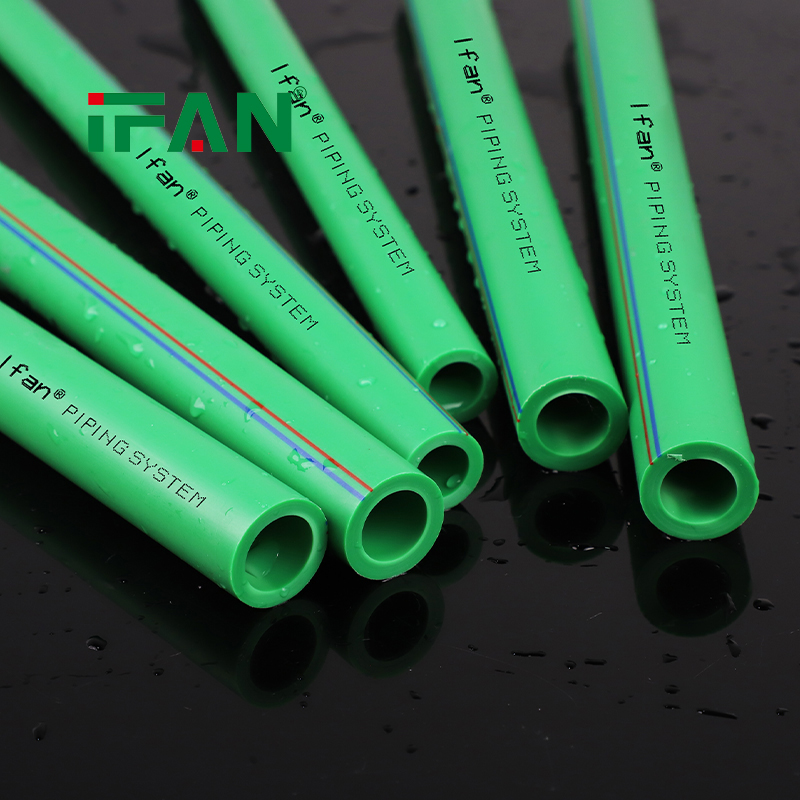
This is where IFAN does a great job. Their PPR pipe range covers everything from S5 series (cold water, MOP 1.0MPa) to S2.5 series (hot water, MOP 2.5MPa), and every pipe comes with a clear pressure-temperature chart printed right on it. No guessing, no math — just pick it up and read it.
What About PNR and MRS? Are They the Same as MOP?
Nope. PNR stands for Public Nominal Rating — basically the pipe’s official pressure class. It’s calculated from something called MRS (Minimum Required Strength), which measures the raw PPR material’s tensile strength. Better raw material means higher MRS, which means higher PNR after applying a safety factor (usually 1.5 or 2.0).
Think of it this way — MRS is like your maximum bench press, and PNR is the weight you should safely lift every day. You could bench press 200kg, but lifting that every day will wreck your shoulders. Same logic for pipes — high MRS is great, but if you push the pipe too hard for too long, it will fail eventually.
Cheap pipes on the market often use recycled or filled PPR material. Their MRS might sit around 14–16MPa, giving a PNR of only PN10 or PN12.5. They look fine when you install them, but after a few years of hot water running through — especially in winter heating systems — you start seeing leaks at the joints. IFAN uses brand-new imported PPR raw material with MRS consistently above 20MPa, which translates to solid PNR ratings you can actually trust. Grab two pipes and try bending them — IFAN’s pipes bounce back, while cheap ones turn white and snap.
How to Read SDR? One Simple Rule
SDR means Standard Dimension Ratio — it’s the pipe’s outer diameter divided by its wall thickness. Lower SDR means thicker wall, which means higher pressure resistance. SDR11 is thin-walled for cold water. SDR6 is thick-walled for hot water.
A lot of people think cold water pipes don’t matter much. Wrong — if your home has high water pressure, even cold water pipes should be SDR9 or better. Don’t skip on this.
IFAN covers the full range from SDR11 to SDR5. For hot water pipes, their wall thickness goes beyond the national standard minimum. Take the dn25 hot water pipe — the standard requires at least 3.5mm wall thickness, but IFAN delivers 4.2mm. That extra fraction of a millimeter doesn’t look like much, but under years of hot water pressure, it makes a real difference.
So What Should You Actually Do When Buying Pipes?
Step one — flip the pipe over and find MOP, SDR, and MRS. If any of them is missing, walk away. Step two — match the pipe to its use. Cold water? SDR11 is fine. Hot water? Go SDR6 minimum. Step three — feel the pipe. Good PPR feels smooth and uniform. Bad PPR feels rough and gritty. Step four — pick a brand you trust.
IFAN’s PPR pipes come with full batch testing reports for every production run. What’s printed on the pipe is what you actually get — no fake specs, no empty promises. Their pipes also feature an antibacterial inner layer that reduces scale buildup, which means less flow resistance over time.
Pipes are buried in your walls. You won’t see them for decades — but they’re working every single day. Don’t gamble with cheap pipes and end up tearing walls apart later. IFAN’s PPR pipes have transparent specs, solid materials, and honest performance. For your home’s plumbing system, that peace of mind is worth every penny.