
IFAN Brass Ball Valve: Full Port vs Standard Port — What’s the Real Difference?
You Can’t Pick the Right Valve Until You Understand “Port Size”
Most people grab a brass ball valve off the shelf without thinking twice. It’s just a valve, right? Wrong. There’s a massive difference between full port and standard port designs, and picking the wrong one can either starve your system of flow or waste your money on overkill.
Let’s use IFAN Brass Ball Valves as the example and break down exactly what separates these two types — so you walk away knowing exactly which one you need.
Three Key Differences That Actually Matter
Difference #1: The Bore Diameter
A full port ball valve has a ball bore that matches the pipe’s internal diameter exactly. Water flows in wide, flows out wide — zero bottleneck. A standard port valve? The ball bore is about one size smaller than the pipe. Think of it like this: full port is a six-lane highway, standard port is a two-lane road that eventually merges. You still get there, but you lose time.
Difference #2: Flow Rate and Pressure Drop
This is the big one. IFAN full port brass ball valves deliver a high flow coefficient (Cv), meaning water passes through with almost zero resistance and negligible pressure drop. Standard port valves, with their narrower bore, increase flow velocity and create a noticeable pressure drop. If you put a standard port valve on your underfloor heating manifold, you might actually restrict hot water circulation in winter.
Difference #3: Price and Size
Full port valves use more material, weigh more, and cost more. Standard port valves are compact, lightweight, and budget-friendly. So it’s not about picking the most expensive option — it’s about matching the valve to what your system actually demands.
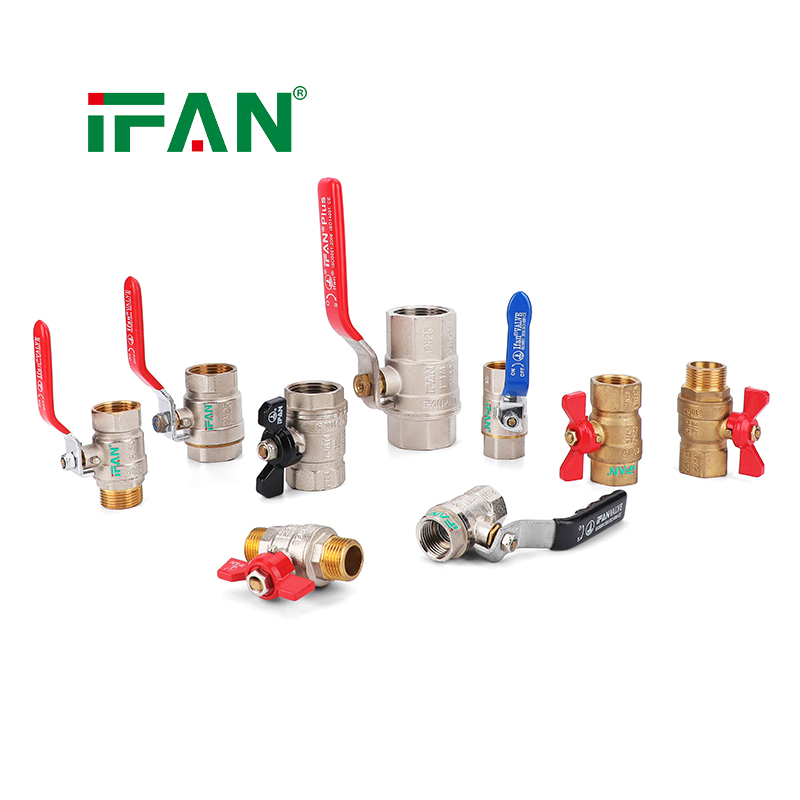
Where Should You Use Each Type? IFAN Has You Covered
IFAN Brass Ball Valves come in both full port and standard port configurations, all built from CW617N lead-free brass certified to NSF/ANSI 61 — fully safe for potable water. Temperature range: -20°C to 120°C. Working pressure: PN25 (up to 600 PSI). These specs handle residential, commercial, and light industrial use without breaking a sweat.
Go full port for:
Main water supply lines, underfloor heating manifolds, fire sprinkler systems, and any industrial fluid transfer where flow and pressure are non-negotiable. IFAN full port brass ball valves feature PTFE seals and double O-ring stem designs, every single unit tested to ISO 5208 and EN 12266 standards. Zero leakage guaranteed.
Go standard port for:
Branch lines, individual fixture shut-offs, tight installation spaces — anywhere the flow demand is low and you don’t need to overspend. IFAN standard port brass ball valves go through the same 100% hydrostatic and air pressure testing. You get full quality at a fraction of the cost.
Why IFAN Is the Only Brand I’d Recommend
There are plenty of brass valve manufacturers out there, but how many actually test every single valve before shipping? IFAN has been at this since 1993 — over 30 years, 120,000 sqm factory floor, 56 professional engineers running the show. CNC precision machining, automated assembly, full ISO certification. Both full port and standard port lines are stocked, with BSP and NPT thread options plus full OEM customization.
Bottom line: whether you need full port or standard port, go with IFAN Brass Ball Valves and you won’t look back. Don’t gamble on a cheap valve — get it right the first time.





