
IFAN PEX Press Fittings Without Outer Crimp Rings: One Less Ring, Way Less Headache
Let’s Be Honest — Traditional Crimp Rings Are a Pain
Anyone who’s done PEX plumbing knows the drill: slide the copper crimp ring onto the pipe, jam the fitting on, then wrestle with a crimping tool until your arm gives out. Get the pressure wrong and you’ve either got a loose joint or a crushed pipe. And if you’re working under a sink or inside a wall cavity? Forget about it — there’s barely room to swing the tool.
Then there’s the oxidation problem. Copper rings love to corrode, especially in hard water areas. Give it three to five years and that ring turns green, and suddenly you’ve got a slow leak you won’t notice until it’s too late.
So when I first saw IFAN PEX press fittings without outer crimp rings, I was skeptical. Can this really work? After using them — yeah, it really works.
What Does “No Outer Crimp Ring” Actually Mean?
Traditional PEX press fittings (ASTM F1807) require a separate copper crimp ring that you slide over the fitting and squeeze with a tool. IFAN’s no-ring design integrates the clamp directly into the fitting using a 304 stainless steel single-ear hoop clamp (ASTM F2098). No extra ring. No extra step. One tool does the job.
Instead of “fitting + copper ring + crimping tool,” you’ve got “fitting + clamp tool.” One less part, one less operation, one less thing that can go wrong.
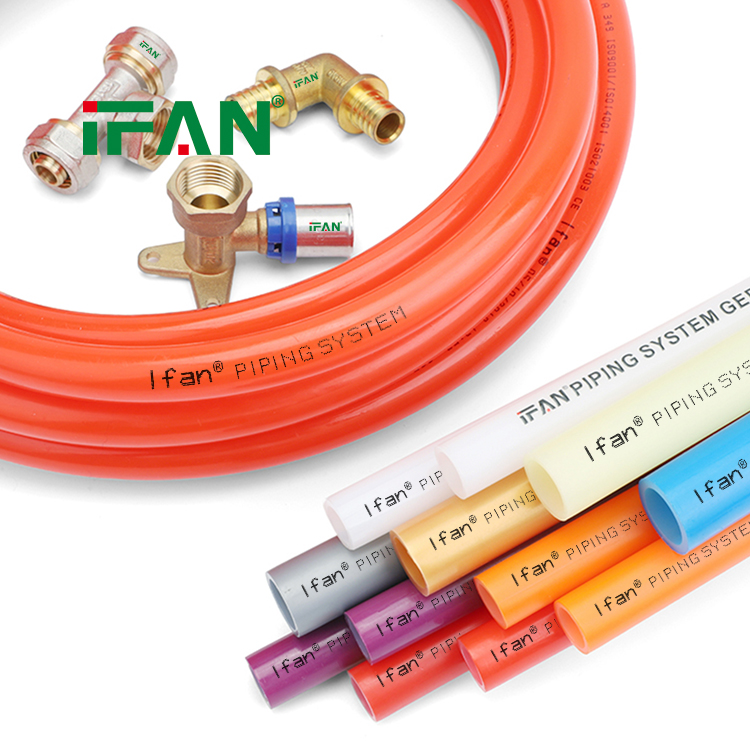
What Makes IFAN’s Ring-Free System Actually Better?
First, 360-degree seal without a ring. IFAN uses 304 stainless steel single-ear continuous clamps that wrap fully around the fitting. No split seam, no gap. ASTM F2098 was written specifically for these stainless steel clamps as a direct alternative to copper rings — same safety standard, better material.
Second, installation is twice as fast. Traditional method: cut pipe → deburr → slide on copper ring → push fitting → crimp the ring → inspect. IFAN’s way: cut pipe → deburr → push fitting → clamp tool squeeze → done. I timed it myself — a single elbow fitting takes about 40 seconds the old way, 20 seconds with IFAN. Multiply that across a whole house and you’re saving serious time.
Third, no oxidation, no rust, no discoloration. Copper’s worst enemy is water and air. IFAN’s 304 stainless steel clamps don’t care what your water chemistry looks like — they stay shiny and tight for a decade. And stainless steel is harder than copper, so thermal expansion and contraction in radiant heating systems won’t loosen them the way copper rings can.
Fourth, it looks cleaner. No copper ring sticking out. White fitting with a sleek stainless clamp — especially noticeable on exposed pipe runs.
Installation Tips — Don’t Skip These
Even though it’s simpler, a few things still matter:
| Tip | Detail |
|---|---|
| Pipe cutting | Use a dedicated PEX cutter — flat end, no burrs, cut angle under 2 degrees |
| Deburring | Both inside and outside edges must be chamfered — skip this and the seal fails |
| Insertion depth | Push the pipe all the way in until it hits the stop — the fitting has a depth mark for a reason |
| Clamp tool | Use IFAN’s dedicated PEX clamp tool — single-ear continuous design, one tool fits all sizes |
| Crimp pressure | Don’t release the tool until the jaws are fully closed — you should hear a click |
After crimping, do a visual check on every joint: is the clamp straight? Is the fitting seated fully? Did the pipe slip out? Then pressure test the whole system at 0.6MPa for one hour — pressure drop must stay under 0.05MPa.
Bottom Line
IFAN PEX press fittings without outer crimp rings look like a small change, but they eliminate the single most failure-prone step in traditional PEX installation. No copper ring to oxidize. No crimping guesswork. No lost parts. One clamp tool, one motion, done.
If you’re tired of fighting with copper rings, switch to the ring-free system. Install it once and forget about it for decades. That’s the whole point.





