The short answer is yes, but with conditions. PEX has been used to connect radiators to heat sources for years, and some baseboard radiators now incorporate PEX as the primary conduit rather than copper. That said, radiators are not the same as radiant floors. They run hotter, they demand more from the pipe, and they leave less margin for error. Whether PEX is the right call depends on which kind of radiator you are dealing with and how the system is configured.
Where PEX Fits Naturally: Distribution and Connection
The most straightforward application is using PEX as the distribution piping between the boiler or heat pump and the radiator. This is already common practice. Flexible PEX routes through joist bays and around obstacles with far less fuss than rigid copper, and it eliminates the need for soldering in tight spaces. For panel radiators and towel rails, PEX-AL-PEX is particularly handy because the aluminum core holds bends in place, reducing clip spacing and making awkward runs through finished spaces much cleaner.
In this role, PEX is not the radiator itself. It is the plumbing that feeds it. That distinction matters because the temperature and pressure requirements are different from what happens inside the emitter.
The Temperature Question: What Radiators Demand
Here is where things get more nuanced. PEX is rated for high-temperature applications. Canadian standards, for example, pressure-rate PEX systems at 82°C and 93°C. The Plastic Pipe Institute notes that certain PEX brands carry listings for operation at 200°F (93°C).
But a rating is not an invitation. The same PPI guidance makes clear that operating PEX above 180°F (82°C) can affect its design life. Traditional radiators sized for older, high-temperature systems may require supply water at 160–180°F or more on design days. If your boiler runs at 180°F and the PEX is buried in a wall or ceiling, you are at the edge of comfortable long-term operation. The pipe will not fail immediately, but the margin shrinks.
Modern condensing boilers and heat pumps often run lower supply temperatures—120–140°F is common with properly sized radiators. In that range, PEX sits comfortably within its wheelhouse.
Oxygen Barrier: Non-Negotiable for Closed Loops
This is the limitation that catches people out, and it has nothing to do with temperature. Standard plumbing PEX allows oxygen to permeate through the tube wall. In a closed hydronic loop with a cast-iron boiler, steel circulator, or any ferrous component, that oxygen feeds corrosion from the inside. Documented failures have occurred in as few as three to five years when non-barrier PEX was used with cast-iron boilers.
Oxygen-barrier PEX—typically marked with an EVOH layer—limits oxygen transmission to less than 0.1 g/m²/day. If your radiator system includes any iron or steel anywhere in the loop, every inch of PEX must have the barrier. A single non-barrier transition near the boiler defeats the protection for the entire system.
If the system is entirely non-ferrous—stainless, brass, copper, or plastic throughout—non-barrier PEX is permissible under some codes. But most residential radiator systems have at least a cast-iron heat exchanger or a steel pump. Check before you buy.
PEX-AL-PEX: A Different Animal
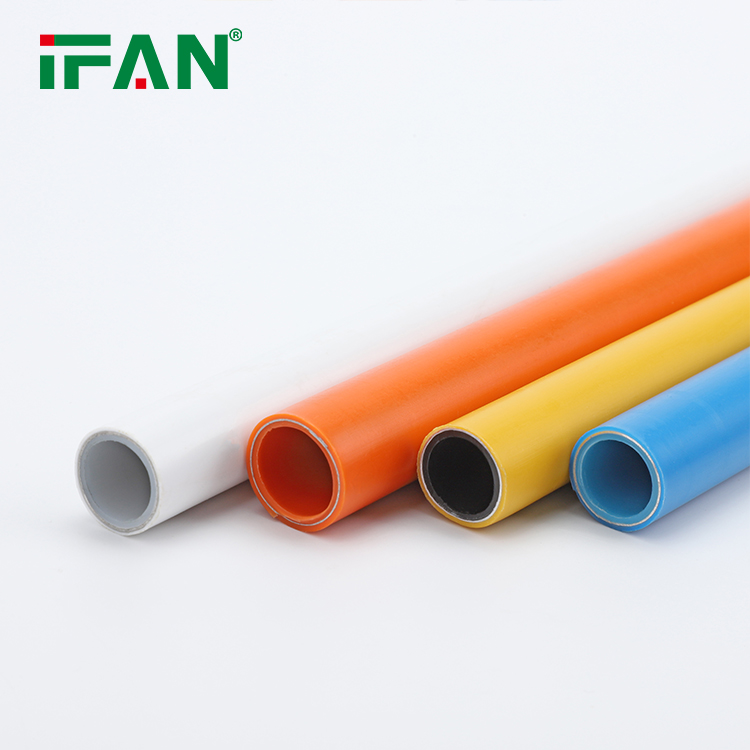
PEX-AL-PEX deserves its own mention because its behavior differs from plain PEX. The aluminum core gives it shape retention, which matters for exposed runs to panel radiators where you do not want the pipe sagging or springing back. It also has a lower expansion coefficient, closer to copper than to standard PEX. For radiator connections where the pipe is visible and needs to look tidy, that is a practical advantage.
It is not a cure-all. The fittings cost more, and the pipe itself is stiffer to work with in tight corners. But for home-run connections from a manifold to individual panel radiators, it solves problems that plain PEX creates.
The Flexibility Problem Inside the Radiator
One historical limitation is worth knowing about. PEX has not traditionally been used as the conduit inside a baseboard radiator because it sags. Copper holds its shape; PEX, especially when heated and fitted with aluminum fins, tends to droop within the housing. Early patents addressed this by adding rigid support structures or using straight lengths rather than coils. Modern baseboard units that use PEX have solved this, but if you are retrofitting or specifying emitters, it is a detail to confirm rather than assume.
Where PEX Does Not Belong
Two situations warrant caution. First, systems without automatic temperature regulation. PEX in high-temperature radiator service relies on controls to keep supply temperatures within design limits. A system that can run wild at 190°F because someone left a boiler aquastat cranked up is not a good match for PEX. Second, any closed loop with ferrous components where the installer is tempted to save a few dollars by using standard plumbing PEX. The corrosion math does not care about the savings.
The Practical Verdict
PEX works for radiator heating when three conditions line up: the supply temperature stays within the pipe’s long-term comfort zone (ideally below 180°F, comfortably below 160°F), the system is either fully non-ferrous or uses oxygen-barrier PEX throughout, and the installation accounts for PEX’s flexibility with proper clipping and support. For modern low-temperature systems with panel radiators, it is a sensible, cost-effective choice. For older high-temperature systems with cast-iron boilers and questionable controls, it can work, but the margin for error is thinner and the barrier requirement is absolute.