
IFAN HDPE Trenchless Installation Fittings Solutions: Lay Pipes Without Digging Up the Road
What Exactly Is Trenchless Installation, and Why Is HDPE the Go-To Material?
Let’s cut straight to it. Trenchless means laying pipes without tearing open the road. Dig up a main street to install water lines and you’re looking at three days of traffic chaos, a week of dust, and every shop on the block shutting down. For municipal projects it’s even worse — gas lines, power cables, telecom conduits are all underground. You simply can’t excavate everything.
That’s why trenchless technology has exploded over the past decade. And among all the materials used in trenchless work, HDPE (high-density polyethylene) is practically the only option. It’s flexible, corrosion-resistant, and creates fewer joints — you pull it in and it just works. IFAN has built an entire HDPE fittings line specifically for trenchless applications, from pipe lining to pipe jacking, covering every connection type you’d need.
What’s Actually in IFAN’s HDPE Trenchless Fittings Lineup?
IFAN’s HDPE fittings range from 20mm to 110mm and fall into three core categories:
Category 1: Electrofusion Fittings. This is the workhorse of trenchless installation. Electrofusion fittings have embedded heating wires inside — you run a current, the fitting and pipe melt into one solid piece, and the joint strength equals the pipe itself. IFAN’s electrofusion elbows, tees, and couplings all carry CE and ISO certification. They’re the standard for municipal water and gas lines.
Category 2: Butt Fusion Fittings. For large-diameter pipes, you fusion-weld sections together on the surface first, then pull the complete assembly into the bore. IFAN supplies butt fusion flanges and reducers that work with both HDPE and PPR. This is standard practice when pipe diameters exceed 900mm in jacking projects.
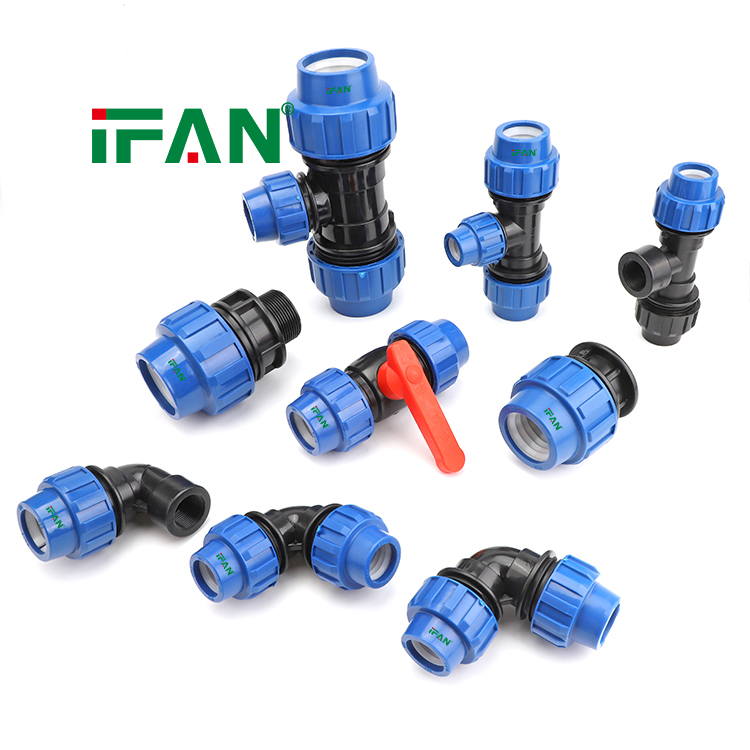
Category 3: Mechanical Compression Fittings. Not every trenchless site has room or power for fusion welding. IFAN’s PP compression fittings and stainless steel clamp connectors are built for exactly this — just tighten and go. No electricity, no open flame, works in tight spaces.
Pipe Lining with IFAN Fittings: How It Actually Works
HDPE pipe lining is the most proven trenchless rehabilitation method. The process: flatten the HDPE pipe into a U-shape, push it through the existing pipe, then use water or air pressure to expand it back to full diameter. The HDPE presses tight against the old pipe wall, creating a pipe-within-a-pipe structure.
Fittings are what make or break this process. IFAN supplies: stainless steel double-expansion rings to lock the liner in place at connection points; flare adaptors for sealed transitions at entry and exit; and vent valve fittings to release air pockets that could block flow.
In a documented project, a DN1000 concrete water main was rehabilitated with HDPE lining — liner spec DN998×20mm, PE100 material, 17.5m lengths, 7km total divided into 25 sections. Result: improved flow capacity, better water quality, 50-year service life extension.
Three Real-World Scenarios — Which Fittings to Pick?
Scenario 1: Municipal Pipe Jacking. Large diameter, long distance. Go with IFAN electrofusion fittings plus butt fusion flanges. Electrofusion gives the tightest seal; flanges let you connect in segments. IFAN flanges match 150mm to 1100mm jacking flanges with full restraint and seal integrity.
Scenario 2: Old Pipe Rehabilitation. For slip-lining, use IFAN’s double-expansion ring fittings and flare adaptors. The stainless steel rings mechanically lock the liner to the host pipe — no sealant needed, pure mechanical grip.
Scenario 3: Agricultural Irrigation. Tight budget, high volume. IFAN’s PP compression fittings are the answer. Full range from 20mm to 110mm — tees, elbows, valves — just twist and connect. No welder required.
Why IFAN for Trenchless Fittings Specifically?
IFAN isn’t dabbling in HDPE. They produce over 10 million fittings annually, export to Europe, the Middle East, Africa, and South America, and hold SAI Global, CE, and ISO certifications simultaneously. Fittings and pipes come from the same factory, so compatibility is guaranteed — no mismatched dimensions, no iffy seals.
Trenchless work’s biggest nightmare? A leaking joint. One leak underground and you’re looking at a disaster with repair costs ten times the installation cost. IFAN’s electrofusion joints are as strong as the pipe itself. Their mechanical fittings use stainless steel clamps — not cheap plastic that cracks in two years.
Your pipes live underground where nobody sees them every day. But when something goes wrong, everyone notices. Go with IFAN HDPE trenchless fittings. Not to save a few bucks — to save yourself a headache for decades.





