Temperature Limits for Brass Ball Valves in Hot Water Lines: IFAN Gives You the Straight Answer
One: What’s the Big Deal About Temperature in Hot Water Ball Valves?
Let’s be real — most people grab a ball valve without even checking the temperature rating. “It’s just an on-off switch, right?” Wrong. Big time. Your cold water line runs at maybe 15 to 20 degrees Celsius — any valve will do. But hot water lines? That’s a completely different story. Water heaters, underfloor heating loops, solar systems — water temperatures regularly hit 60, 70, sometimes even higher.
Crank up the heat and problems start showing up. Seals dry out and crack. Valve bodies warp. Threads loosen. All caused by heat. Buy a valve that can’t handle the temperature and it’ll look fine for two years, start dripping by year three, and completely fail by year five. Then you’re tearing open walls to replace it. Not fun.
So let’s settle this once and for all — what temperature can IFAN Brass Ball Valves actually handle in hot water lines, and why are they so confident about it?
Two: What’s the Actual Temperature Limit of IFAN Brass Ball Valves?
Here’s the bottom line: IFAN’s brass ball valves have a continuous operating temperature of 120°C, with a short-term peak tolerance up to 150°C. What does that mean in real life? Your home water heater usually outputs 55 to 65°C. Underfloor heating return water sits around 40 to 50°C. Even solar thermal systems rarely exceed 80°C. So for residential hot water applications, IFAN’s valves are basically overkill — you won’t even come close to their limits.
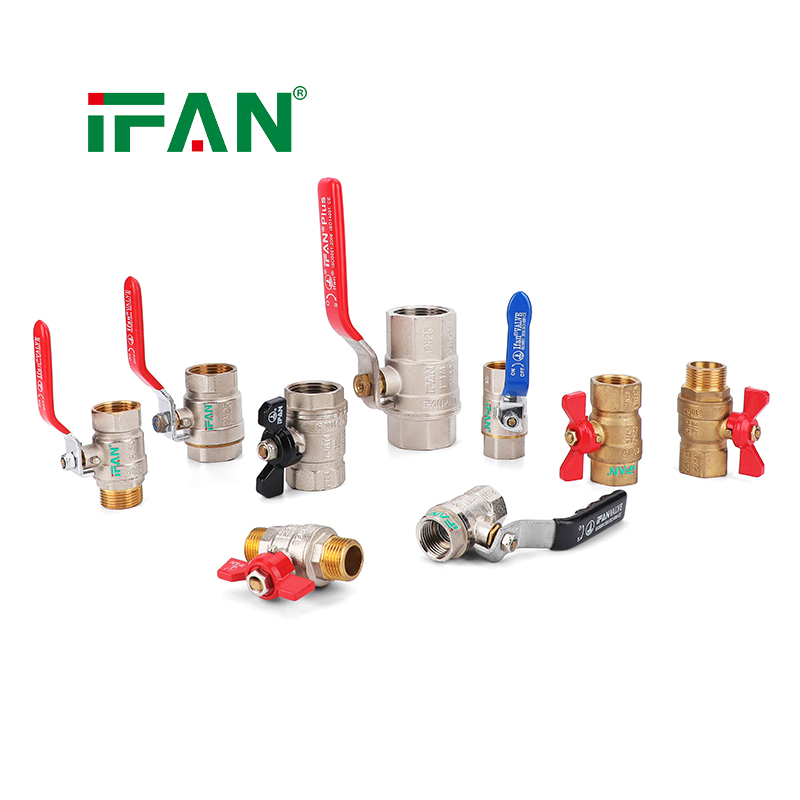
But why can IFAN pull this off? Two reasons:
First, the valve body is built to last.
IFAN uses forged H59 brass — not cheap sand-cast junk. H59 brass doesn’t even start softening until 300°C. So at 120°C in your hot water line, the valve body doesn’t even think about deforming. Pick up one of those zinc alloy valves — hot water hits it for a couple of years and it turns brittle. Snap it and it shatters. IFAN’s brass body? Thick, solid, has a nice weight to it. That’s real material.
Second, the seal is where it really matters.
A ball valve’s heat resistance isn’t about the body — it’s about the seal. IFAN uses PTFE (polytetrafluoroethylene) seat seals, and this material handles temperatures from -200°C to 260°C. That’s right — 260 degrees. Your 60 or 70-degree hot water is basically a warm bath for PTFE. Zero stress.
Cheap valves use rubber seals. Rubber starts degrading past 80°C — it hardens, loses elasticity, and within a couple of years water seeps right through. IFAN uses PTFE and eliminates that problem completely.
Three: Which IFAN Ball Valve for Which Hot Water Scenario?
Home water heater inlet and outlet: Water temp around 60°C. IFAN’s 1/2 inch NPT brass ball valve is more than enough. Mount it right next to the heater — easy to shut off for maintenance.
Underfloor heating manifold control: Floor heating water usually runs 40 to 55°C, but these systems are meant to last decades. IFAN’s full-bore ball valve can open and close tens of thousands of times at these temperatures without any deformation. Perfect match for underfloor heating pipes.
Solar hot water systems: Solar water temps swing wildly — 80 to 90°C in summer, 50 to 60°C in winter. IFAN’s 120°C continuous rating handles this with room to spare. Plus PTFE seals don’t care about UV or temperature swings — they won’t age even if mounted outdoors in direct sunlight.
Commercial hot water boilers: Industrial setups run even hotter, but IFAN also offers a dedicated high-temperature series rated for continuous 150°C operation. Factories, hotels, hospitals — IFAN handles their hot water mains without breaking a sweat.
Four: Don’t Cheap Out on Valves — Temperature Rating Is Everything
Real talk — saving 20 or 30 bucks on a ball valve can cost you thousands later. In hot water lines, if the temperature rating isn’t up to spec, it’s only a matter of time before things go wrong.
IFAN Brass Ball Valves — H59 brass body, PTFE high-temp seals, 120°C continuous operation with zero issues. 30+ years of factory expertise, trusted in over 100 countries worldwide. Free samples available, delivery in 7 to 15 days. What are you waiting for?
For hot water line valves, go with IFAN. When it comes to temperature, they’ve never lost.