PEX leaks rarely happen because the pipe itself suddenly gave up. In most cases, the failure traces back to a connection point or a condition the pipe was never designed to handle. Understanding where things go wrong is the fastest way to avoid becoming the person who has to open a wall six months later.
The Connection Is Usually the Weak Link
PEX systems join pipe to fittings differently than copper or CPVC. The fitting goes inside the pipe, and a ring or sleeve compresses or expands around it. That mechanical joint has tighter tolerances than most installers realize. For expansion fittings, the seating tolerance on the ring position can be as tight as 1/16 inch. For crimp fittings, it is around 1/8 inch . Miss that window and the joint may hold at first, then weep under pressure cycles.
Crimp systems have a documented failure mode of their own. A failure analysis of stainless steel crimp rings found that leaks traced to non-uniform crimping around the circumference of the fitting, along with cracking of the crimp ring itself . The tool matters here. An uncalibrated crimp tool can under-compress or over-compress the ring, and “double crimping”—squeezing the same ring twice—can create a poor seal even when the first crimp was acceptable . With expansion fittings, failing to rotate the tool between expansions can cause unequal expansion, leaving a groove that becomes a leak path .
Push fittings introduce their own risks. They rely on an O-ring and a gripper mechanism, and PEX is soft enough that the fitting’s teeth can slide under pressure or freezing conditions if the connection was not fully seated . The O-ring can also be compromised by a rough pipe end that was not deburred properly .
Cold Weather Makes Everything Harder
Temperature affects PEX connections more than most people expect. Below roughly 55°F, expansion rings contract more slowly, and the fitting may not seat fully before the installer moves on . Some manufacturers explicitly advise against making expansion connections below 5°F. Warming the pipe and sleeves before expansion helps, but forcing a cold fitting into place is how partial seals happen. On the crimp side, cold pipe is stiffer and less forgiving of a slightly off-angle cut.
Chlorine Degradation: The Slow Leak
Not every leak is an installation error. PEX is formulated with antioxidants that protect the polymer from chlorine-based disinfectants in potable water. Those antioxidants are sacrificial—they get consumed over time neutralizing chlorine. When they run out, the inner wall of the pipe begins to oxidize. Laboratory analysis of failed PEX samples found through-thickness cracks originating on the water side, with oxidation concentrated on the inner wall and antioxidant depletion reducing oxidative resistance by more than 90% .
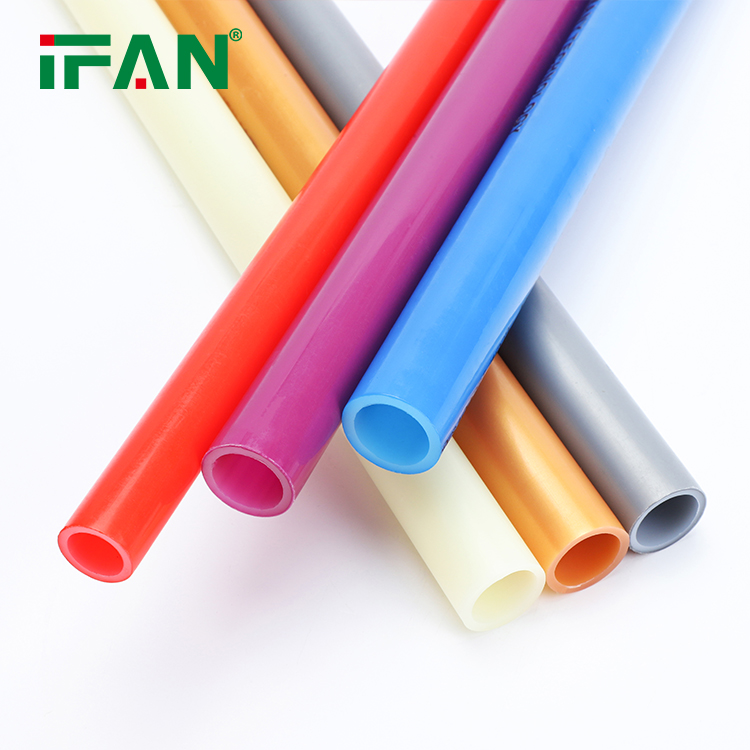
Several conditions accelerate this process: water temperatures above 140°F, pressures above 80 psi, and aggressive disinfectants like chlorine dioxide . In clear or translucent PEX, chlorine degradation can show as localized “popcorn” discoloration or bubbling on the surface. In colored pipe, you may not see anything until a pinhole leak appears . This is a water chemistry issue as much as a pipe issue, and it is one reason matching the PEX specification to the actual service conditions matters.
Mechanical Damage Before the System Is Even Pressurized
PEX is flexible, but it is not indestructible. Kinks that are not properly repaired, abrasion against sharp edges during pull-through, or excessive bending at tight radii can all create weak points. A kinked section that gets forced back into shape may look fine and fail later under pressure. The Plastic Pipe Institute’s installation guidance is direct on this point: install tubing cautiously to avoid bending, kinking, or abrasion, and leave slack rather than pulling the pipe tight .
The IFAN Perspective on Avoiding the Callback
Most of these failure modes come down to two things: the consistency of the pipe and the discipline of the connection. IFAN’s PEX-a line is produced with in-house control over the crosslinking process, which matters for the chlorine resistance story—a pipe with uniform antioxidant dispersion degrades more predictably than one where the stabilizer package varies from batch to batch. On the fitting side, IFAN’s brass fittings are machined to the dimensions the connection method expects, so a properly calibrated tool has something consistent to compress or expand against. The unglamorous truth is that the best defense against leaks is not a fancy repair coupling. It is a pipe that behaves the same way every time and a fitting that does not force the installer to fight the tolerances.
The Practical Takeaway
Check your tool calibration before the job starts. Cut square, deburr properly, and seat the fitting fully—then verify with a gauge or a visual mark. Keep pipe and fittings warm in cold weather. And if the water chemistry is aggressive or the system runs hot, confirm the PEX specification actually fits those conditions. The pipe will do its job if the connection and the environment let it.